





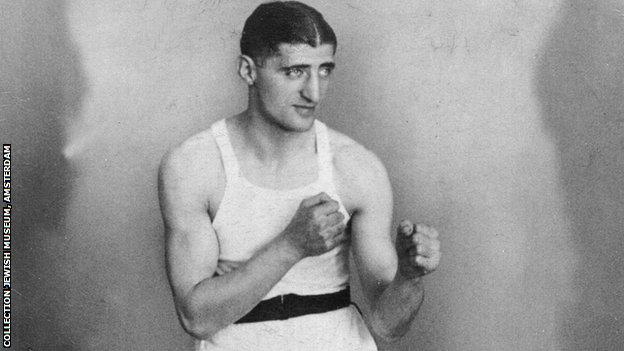
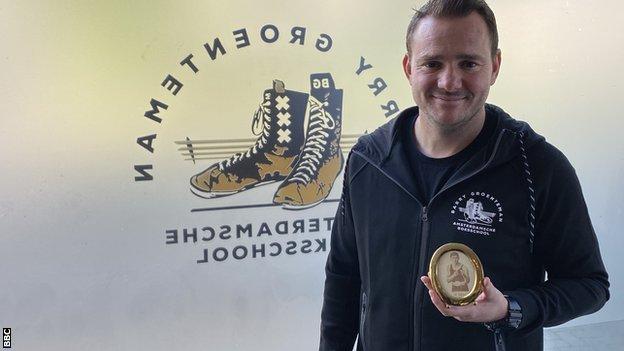
Sitting in his boxing gym just outside Amsterdam, former Dutch champion Barry Groenteman is reminiscing about the times he used to visit his grandmother.
When she was living in a retirement home and he would go to see her, he’d often come across an older man “who was always shadowboxing: in the hall, with the nurses”.
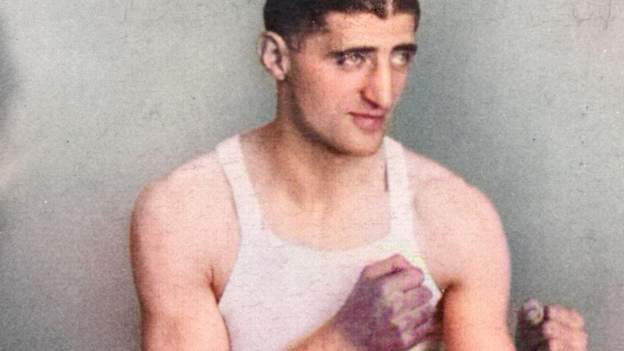
Groenteman continues: “He’d show me his ring, with the Star of David on it. And my grandmother would whisper: ‘That’s Ben Bril.'”
For the young Groenteman, it was an introduction to a man who would have a huge impact on him and whose story he feels compelled to tell.
Like him, Bril grew up as Jewish boy in Amsterdam, and – also like him – boxing became his life.
But there the comparisons end. Groenteman was born in 1986. Bril was born in 1912. By the time he reached his 30s, his life had been transformed by invasion, violence and anti-Semitism.
On Monday, the Dutch boxing world will come together to celebrate the return of the Ben Bril Memorial night, at Amsterdam’s famous Carre Theatre.
Those gathered will remember how a serial national champion was forced into hiding and then sent to the Nazi concentration camps by a former Olympic team-mate. They will look back on his remarkable survival and consider his legacy today – inside and outside of the ring.

Bril grew up in one of the poorest parts of Amsterdam as the second youngest of seven children.
It was a tough upbringing, according to Steven Rosenfeld, who is a relative of Bril’s through his wife Celia and has written a book about his life: Dansen om te overleven (A Dance with Survival).
“They lived in tenements, he didn’t sleep in a bed, he slept on straw, they didn’t have a toilet, he had to carry buckets down to the street,” Rosenfeld says.
For the young Bril, fighting was a part of daily life. There were scraps with friends of course, but also clashes with rival groups from different communities in the tightly packed city, according to Ben Braber, a historian who has written extensively about Jewish life in Amsterdam during the inter-war years.
But while some of his friends carried on brawling, Bril turned his hand to sport.
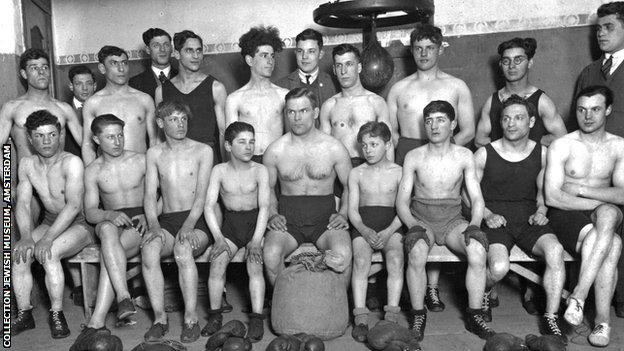
“Boxing was very popular in the Jewish quarter before World War II,” says Braber.
“For some boys, it was hard fist-fighting for gamblers, but other young Jews joined clubs. They were popular because the training and the matches were an escape from daily routine, also [from] daily poverty.
“And [the young men] built their self-esteem, because the art of self-defence requires courage, stamina, quick reactions but also technical skills.”
Bril was one of those young men, and his career sparked into life early when – at the age of only 15 – he was selected to fight for the Netherlands at the Amsterdam Olympics of 1928.
He turned 16 on the opening day of the Games (there are some suggestions he had to falsify his birthdate in order to qualify and was in fact only 15) and reached the quarter-finals in his weight class – flyweight.
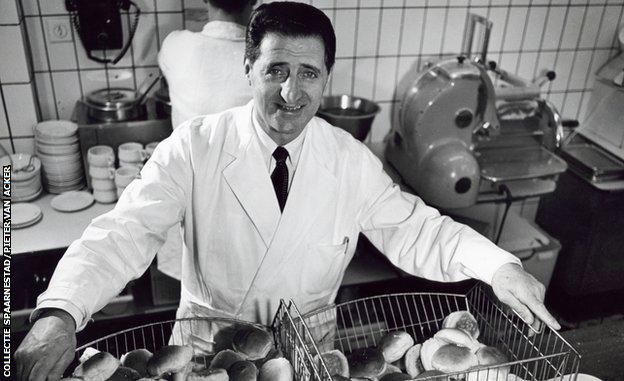
As he got older, Bril found work in a butcher’s shop, and used his new job to help develop his sport.
“He told me that when he had to chop up meat he always used his left hand, even though he was naturally right-handed, to strengthen his left jab,” Braber remembers.
Rosenfeld recalls Ben’s “brick-like” hands, toughened, he was told, by dipping it into pickle brine.
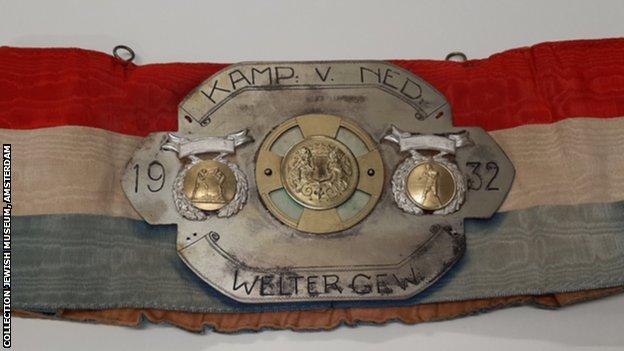
Through the late 1920s and the 1930s Bril became a serial champion, winning eight Dutch titles and national fame.
But life in Amsterdam would change dramatically over those years – especially for Jews like him.
Economic crisis, the rise of Nazi Germany and an associated increase in anti-Semitism in the Netherlands made discrimination against Jews increasingly prevalent.
Bril experienced this directly when, despite his domestic success, he was left out of the Dutch team for the 1932 Olympic Games in Los Angeles.
At the time, says Rosenfeld, he didn’t fully understand what had happened, but it later became clear that he was blacklisted by anti-Semites on the Dutch national boxing committee.
Despite that, three years later in 1935 Bril claimed what, for him, would always be his greatest success – and the source of that Star of David ring he wore even as an old man.
He travelled to Tel Aviv, in what was then Mandatory Palestine, to take part in the second edition of the Maccabiah Games for Jewish athletes from around the world.
He and a fellow Dutch Jew, his friend Appie de Vries, both won gold medals and returned to a hero’s welcome among the Jewish community in Amsterdam.
It was at about this time that Bril started wearing the Star of David on his shorts, to match the ring he had won.
It is something of a tradition among Jewish boxers to wear the Star in that way and Bril was certainly not the first.
The great 1920s American lightweight Benny Leonard, known as ‘The Ghetto Wizard’, did it in his heyday.
And, much later, as his own career took shape, Barry Groenteman would honour the man who inspired him by himself displaying the Star of David in the ring.
For Braber though, Bril’s act of identifying himself in that way, in 1930s Netherlands, is “very significant”.
“He clearly identified himself as being Jewish, but he also wanted to be identified [by others] as being Jewish – that was an important matter to him,” he says.
Right up to 1939, Bril was still wearing the Star in the ring, and handing out signed publicity photos of himself wearing those trunks.
Rosenfeld, who also interviewed Bril extensively for his book, says Bril’s first motivation in wearing the Star was an expression “of his sports accomplishment” in winning at the Maccabiah, rather than a political statement.
But he was clearly well aware of the wider situation around Europe and wasn’t afraid to act on his own initiative.
In 1934, Bril went with a Dutch Jewish group to compete in Germany.
The Nazis had been in power for a year. The state had already begun to discriminate officially against Jews. The atmosphere was hostile and daily life was being made increasingly difficult.
Bril was appalled by what he saw.
“We saw brown uniforms everywhere, swastika flags, the word ‘Jew’ on Jewish people’s businesses,” Bril told a Dutch newspaper many years later.
“I said then, as long as this regime is in power, I will never go to Germany.”
Despite his hurt at being overlooked for LA four years earlier, when the call came in 1936 for the Dutch champion to travel to Berlin for the Olympic Games, he turned it down.
As his amateur career continued and his fame grew, Bril married his wife Celia. They had a son – Abraham – and opened a sandwich shop in the city of Utrecht.
But their lives, and those of everyone in the country, were turned upside down by the outbreak of war in Europe in 1939. In May 1940 Germany invaded the Netherlands.
Initially little changed, but gradually life for Dutch Jews became more restricted, and increasingly under threat.
“In 1941, stricter regulations came in which were clearly an attempt to segregate the Jews in the Netherlands from the rest of the population,” historian Braber says.
There were restrictions on which public spaces Jewish people could enter, and in particular an attempt to force bars and cafes to ban Jews from their premises, which often ended in violence.
This sparked the creation of a number of Jewish defence groups, some centred around the sports clubs like the one of which Bril was a member.
On 11 February 1941, Dutch Nazis marched into the Jewish district of Amsterdam.
A previous incursion two days earlier had resulted in attacks on Jewish homes and businesses, and there was a fear, says Braber, that synagogues would be the next target.
So the defenders – armed with bricks, metal bars, anything they could get their hands on – prepared themselves for another confrontation.
This time it was even more violent and bloody, “a ferocious battle”, says Braber, that resulted in the death of at least one Nazi and led to repercussions against the Jewish community.
Within two weeks some 400 men had been rounded up and deported – many survived no more than a few months.
Although Braber was told by a friend of Bril’s that Bril was involved – and many men he knew certainly were, including his trainer and a number of fellow boxers – it is unlikely that the champion took part directly in the fighting.
Rosenfeld says Bril was told to stay away, because his fame might make him a target.
But the brief confrontation in Amsterdam’s Waterlooplein square, with Jewish fighting groups at the core – “a form of Jewish resistance unique in Europe,” says Braber – was a stark demonstration of how life in the city had changed.
The intimidation, violence and official discrimination continued to grow in intensity in the months that followed and in July 1942 – shortly after it became compulsory to wear a yellow star – came the first deportations of Dutch Jews.
“At that point virtually nobody in the Netherlands knew exactly what was happening in those camps where Jews were sent,” says Braber.
“What we know now about gas chambers and extermination camps only became clear after the war. Nonetheless, some 20% of people who were called up [for deportation] didn’t turn up, and went into hiding.”
That number included Bril and his family. As Braber points out, the decision to hide was a perilous one: “‘Can we stay together, can we get help, are these people trustworthy?’ All these types of things you have to think about.”
According to Rosenfeld, the Brils were sheltered in a variety of different places and – despite the danger – were often out and about.
But eventually they were betrayed and held in custody – in a bitter echo of Bril’s sporting life – by Sam Olij, who had been Bril’s team-mate on the Olympic boxing squad of 1928.
Bril had also boxed with Olij’s sons in Amsterdam, but the Olij family had become committed Nazis. According to Dutch sports historian Jurryt van de Vooren it was Olij’s son Jan who arrested Bril and his wife and son.
The Bril family were sent to the camps. First to Vught in the Netherlands, then – up by the German border in the north – to Westerbork, and finally to Bergen-Belsen, where it’s estimated 50,000 people died, Anne Frank among them.
De Vooren has described Olij as “a notorious Jew hunter” who committed “the worst kind of betrayal in Dutch sport”. After the war, he served nine years’ imprisonment and died in 1975, while his son Jan was said to have fled to Argentina.

There is one moment that stands out from Bril’s life in the war beyond all others. It was a moment fraught with danger, but one in which he acted instinctively. It came at the Nazi concentration camp at Vught, and we can hear about it through Bril’s own words, because he told the story to Braber in the 1980s.
“A boy had attempted to escape [but] they caught him,” said Bril.
“They placed him on a rack, and he was to get 25 lashes of a whip. Suddenly the commander called out: ‘Boxer – step forward!’
“I had to carry out the punishment, but I refused. The commander said that if I didn’t I would get 50 lashes, so I took the whip but when I hit him, I aimed to strike too high.
“The commander got mad: ‘Not so!’ he cried. He grabbed the whip and started beating like mad. I walked back to my line.”
Why Bril suffered no consequences for his refusal to carry out the order is not known, but those who witnessed it were under no doubt as to what they had seen.
“[Ben Bril was] the only man I saw during two and a half years in concentration camps – or heard of – who risked refusing to carry out a formal order of the SS,” Braber quotes the head of Vught’s Jewish administration as testifying after the war.
It was, says the historian, “a very courageous act”.
But Bril would also have to fight in the camps, both in Vught and in Westerbork. As a famous boxer he was a target – someone who the guards might want to see in action.
In 1988, on Dutch television, Bril told of one life-changing moment. “I boxed for my son, who was dying,” he said.
He was to fight against a ‘kapo’ (a camp inmate who was appointed by the Nazis to guard and control the other prisoners) in Vught.
The man asked Bril not to knock him out. He replied that he would comply on condition that the man help him get medicine, and agree not to beat the inmates in his block.
Steven Rosenfeld says the man complied, and Bril’s son overcame his illness.
Bril also helped organise fights which were staged for the entertainment of the camp authorities. Those taking part might have got extra rations or other benefits, according to Braber.
Groenteman made a powerful television programme about Bril’s story and recalls being shown, by a former inmate, the papers detailing some of the fights in Camp Westerbork.
“I saw such a lot of names I know, I know their grandchildren,” he says.
“The scariest thing was that they were so similar to the schedule papers that hang in changing rooms now, when I’m going to an amateur event with my guys. That was hard.”

Almost all of Bril’s extended family died in the Holocaust, but his son Abraham and his wife Celia survived the war along with him.
In January 1945, from Bergen-Belsen, the family were included in a prisoner exchange that saw them taken first to Switzerland, then to a United Nations camp in Algeria, before making it back to Utrecht.
Bril didn’t return to the ring as a fighter after the war, but he couldn’t leave boxing.
He became a senior official in the sport, acting as a referee and judge at fights around the world, all the way into the 1970s.
He went to the Olympic Games in Tokyo in 1964 (where he once again showed his character by leaping into the ring to protect a fellow referee who had been punched by a competitor), Mexico City in 1968 and Montreal in 1976.
He missed the 1972 Games in Munich, and its own tragic story, only because of a dispute with the boxing authorities in the Netherlands.
Ringside or on the canvas, he played a small role at the start of the careers of some of the greats, officiating in fights involving world champions Joe Frazier, George Foreman and Sugar Ray Leonard.
Bril died in 2003 at the age of 91. The first memorial night in his honour was held four years later.
Groenteman made his first appearance at the Carre at the 2011 event. He fought with the Star of David on his trunks, both to honour his family and the man who had inspired him as a youngster.
“I think that day I boxed the best fight in my whole career,” he says.
“People get their strength from their religion, from meditation, from mindfulness, from where they come from. I always felt when I was boxing with the Star on my trunks, it gives me more power.
“We’re raised up with the attitude: ‘Never walk away from where you come from.’ Ben Bril stood for who he was.”