







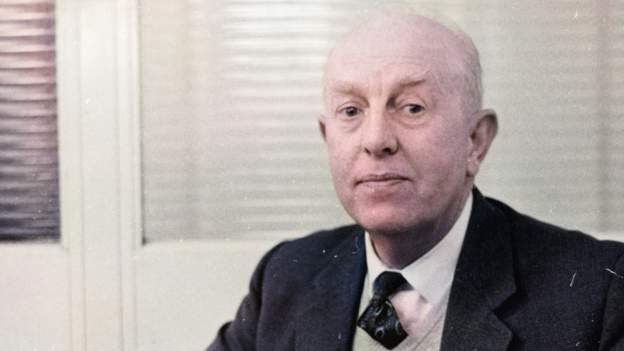
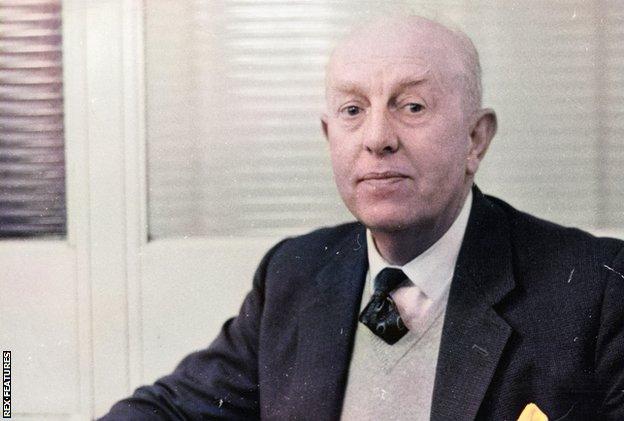
Unlikely as it may seem, a military airfield in Bedfordshire used in World War One can be identified as the location where British football analysis found its spark, almost a century ago.


RAF Henlow was the country’s first parachute test centre and future jet-engine inventor Sir Frank Whittle studied there. It was only a decade old when Thorold Charles Reep arrived as a new recruit in 1928.
Reep would go on to become a controversial figure in English football history. His innovative studies led to the basis of football data collection and analysis as we know it today, but the motivation behind his work was often incorrectly interpreted.
Usually stereotyped as a long-ball loving zealot who ruined the game, his only goal was to uncover football’s inner workings and ultimately establish the most efficient and attacking style of play, which he arguably achieved to a greater degree than anyone had before.
Even in today’s data-intensive sporting landscape, 20 years on from his death at the age of 97, Reep’s impact can be felt. But his reputation does not reflect the achievements of a man often misunderstood.

Born in Cornwall in 1904, Reep grew up an avid fan of Plymouth Argyle. At the age of 24 he joined the RAF as an accountant and was posted to Henlow.
It was too far for him to travel to Argyle home games so he visited Highbury to watch Arsenal as often as he could. This was a golden period for the Gunners; after winning their first FA Cup in 1930 they were league champions four times over the next five seasons.
It was therefore a coup when Arsenal captain Charles Jones agreed to give two three-hour lectures on football tactics at RAF Henlow in 1932. In a drafty hut, beside a large blackboard and easel, Jones spoke eloquently about manager Herbert Chapman’s methods for success, apart from a small hiccup when he retired behind the board to adjust his newly fitted false teeth. Reep was in the front row, ferociously making notes.
Jones’ talk inspired him to find new ways of scrutinising what he was watching on the football pitch, and he began to experiment by making analytical match notations. He called his first attempt a ‘Tactic Crime Chart’.
Having observed players often failing to make the most of certain openings at Highbury, he also designed a system of grading the difficulty of chances around the goalmouth – a very early version of the expected goals (xG) metric widely used today.
Reep took on board the fundamentals of Arsenal’s style of play under Chapman before the manager’s sudden death in 1934 at the age of 55. Players were told to hit long balls out to the wingers, who were to stay just onside without tracking back. Instead the team would try to win the ball as far up the pitch as possible, with the forwards chasing down defenders in possession.
When Reep was posted to Iraq in 1936, he was put in charge of the RAF base team and implemented the Arsenal tactics Jones had explained. The rewards were instant, but Reep’s determination to experiment further was curtailed by conflict.
After World War Two, he returned to RAF Yatesbury in Wiltshire in July 1947 and was appointed head of football. There he had a chance to shape a team around a system of his own design that he called ‘Loose Balls in the Goalmouth’. In essence, players were drilled to capitalise on various scenarios where wingers could pick up ‘easy’ tap-ins when the ball came across from the opposite flank. Yatesbury had great success – and several players signed with league clubs.
When in 1950 he was posted to the RAF base in Bushy Park near Kingston upon Thames, which just a few years earlier had been General Eisenhower’s European base of operations, the station team was urged to follow his ideas. They were soon winning games by huge margins, with the wingers regularly scoring hat-tricks.
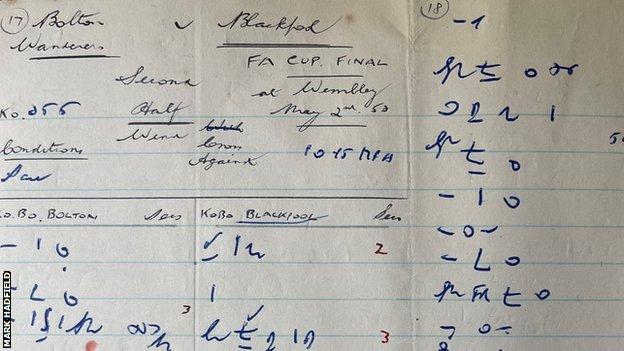
At the same time Reep was continuing to collect and analyse football data, advancing the unique shorthand method he had devised at Henlow and applying it to as many First Division games as he could.
He arrived at a number of findings: seven out of nine goals came from moves of three passes or fewer; moves starting with a long pass from your own half meant a goal was twice as likely to be scored when compared to using only short passes to progress up the field; most goals came from winning the ball back in the attacking quarter of the pitch, something Reep called a ‘regained possession’.
He also found that, no matter what the standard of play, on average it took around nine shots to produce a goal. His next move was to calculate how these shots could be created. Getting the ball into the final quarter was something he called a ‘Reacher’, meaning the team had reached a shooting position.
He found that an average of three ‘Reachers’ were needed to produce a shot, and as nine shots were required to produce a goal, a team would need to reach the attacking quarter 27 times to score. These were not things that could be relied on in individual matches but were merely the averages attained over a series of matches or a whole season.
Reep’s deconstruction of the game through numbers might seem obvious now, but it had not been broken down like this before.
He was soon attracting wider attention.
In January 1951, Reep’s RAF team were rampaging through their matches. Five miles away in west London, Brentford manager Jackie Gibbons was in trouble and needed some help for his failing Second Division side. With no money to spend and a squad low on confidence, he was desperate for inspiration.
A scout told Gibbons about the team down the road that had recently won 12-1.
“There’s some crazy fellow who stands on the touchline with bits of paper making notes,” he reported. “[He] produces a tactical plan which seems to work.”
Gibbons visited Bushy Park and two days later Reep was on the team coach to Doncaster.
Brentford were 16th in Division Two and had not won away from home since September. On that day, the first time that a Football League team was taking notice of Reep’s advice (and with Ron Greenwood and Jimmy Hill in their playing ranks), the Bees won 3-0. Gibbons was delighted.
The young manager agreed to fully adopt Reep’s tactical plans.
Bury at home was the next match and Brentford won 4-0. Press reports described their “whirlwind attacks”, which today might be compared to the high-intensity pressing favoured by teams such as Jurgen Klopp’s Liverpool.
“An unbelievable and instant success,” wrote Reep. Brentford jumped up the table. Having won only nine of their 29 league matches (31%) before Reep’s involvement, scoring 1.3 goals per game, they then won nine of their last 13 (69%) while scoring 2.9 goals per game, ensuring they finished a comfortable ninth place.
For Reep, it was just the start.
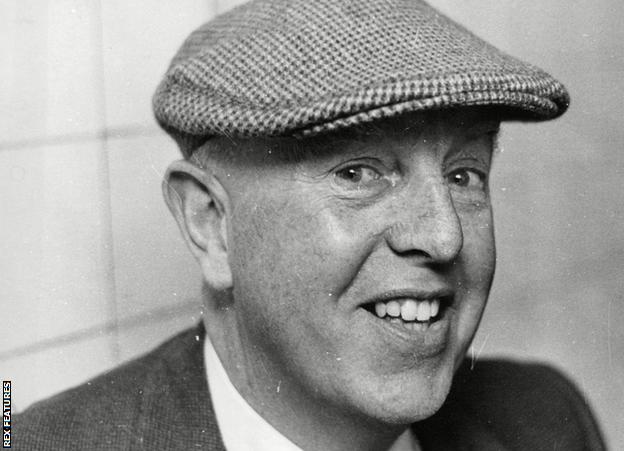
In August 1951, he was posted to RAF Bridgnorth and soon contacted the local side, Wolverhampton Wanderers. They were led by Stan Cullis, the ‘Iron Manager’; a physically intimidating man with a nose that had made acquaintance with many centre forwards’ elbows. A devout Christian, he was known to celebrate big wins with a cup of tea.
Cullis had won Wolves the 1949 FA Cup and was already on the way to great things at Molineux. Soon after meeting Reep, he began working with his wingers on the ‘Loose Balls in the Goalmouth’ system. Wolves scored 25 goals in their next seven matches.
Reep was brought in closer for the 1952-53 season, but still recalled being “regarded with uneasy suspicion by the directors, who understood absolutely nothing of the fundamental principles that were bringing the team’s great success”.
With Reep and Cullis working in the same direction at least, by early November Wolves were top of the First Division following a 7-3 win at home against Manchester City. A few games earlier they had beaten Manchester United 6-2.
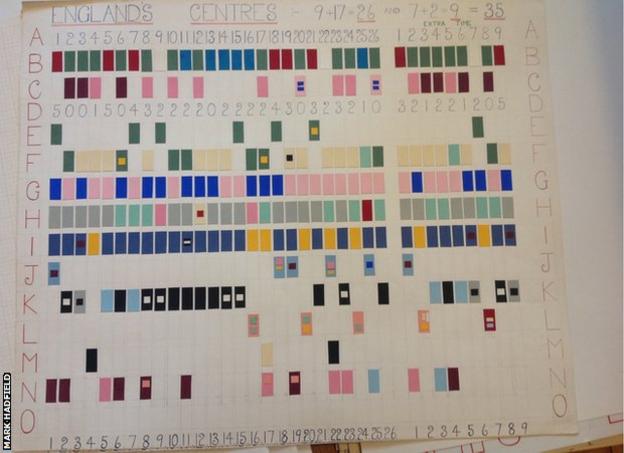
Reep was still working on ways to gain more information from his data and his weekly deliveries of charts and tables were eagerly awaited by the manager. By now his shorthand notes contained more than 2,000 symbols per match.
After driving home from games he would spend Saturday night and most of Sunday hunched over his data, producing his breakdowns sometimes on sheets of paper two feet wide, all handwritten in his spidery, almost unreadable script.
What Reep offered was the analogue equivalent of the data obtained by top-class teams today. At the time it was just as cutting edge.
That season Wolves faded to finish third but the following year they came back stronger. When they beat Tottenham 2-0 on 24 April 1954 and were crowned league champions, Reep felt vindicated. The city of Wolverhampton was ecstatic and Cullis celebrated by putting the kettle on. At a civic banquet in honour of the team, the great manager publicly thanked his analyst. Wolves were one of the teams of the decade and would be champions again in 1958 and 1959.
From his first league experience with Brentford to Wolves winning the title three years later, Reep had made unbelievable progress in the fields of football data and analysis. This was to be the high point.
Reep left Wolves for Sheffield Wednesday in 1955. He had never been formally employed at Molineux and the job at Hillsborough offered security and more money. He helped the Owls win promotion to the First Division as champions in 1956, scoring over 100 goals, before leaving two seasons later when the manager who brought him in, Eric Taylor, was sacked.
His journey continued at several other English clubs, including Coventry, Torquay and Plymouth in the 1960s and 1970s, then Stoke City, Chesterfield and Cambridge in the 1980s – but never again would he find a place at the top of the English game. And his reputation suffered.
It was interpreted in some places that Reep only wanted to hoof the ball forwards quickly and without direction, a label he has been tarred with to this day. In fact there was nothing directionless about the style of play he encouraged – wingers and attackers were told to be in very specific positions to make the most of any opportunities.
His main belief was that winning the ball close to the opponents’ goal was most important in creating goals, although he wanted to generate as much offensive threat with as little fuss as possible. And in his later years he did begin to see positives in possession-based play – making several studies of Serie A football in the 1990s.
“I must emphasise that my methods are not a declaration of how football should be played,” he was at pains to explain. “But it is the most efficient way.”
Reep continued to follow his passion for football data, making handwritten analyses when he was well into his 90s. He was a reference point and inspiration for those who followed – such as Richard Pollard, who collaborated with Reep to produce the game’s first computer analysis in 1969.
His last telling influence on the game came in the build-up to the 1994 World Cup, but it was not in aid of his own national side.

Under the management of Graham Taylor, a disappointing 1-1 draw in Poland on 29 May 1993 meant England could ill-afford to slip up in their next qualifying fixture four days later in Norway.
Then aged 88, Reep was held in high regard by Norway’s manager Egil Olsen, who was a professor of sports science and had taught the subject for 20 years before taking charge of his national team.
Olsen became the latest in a long line of football people to seek Reep’s advice, flying into Heathrow and travelling down to his Devon home for a five-hour discussion on performance analysis.
For the game against England, Reep was invited to attend as a guest of honour by the Norwegian Football Association. And Norway played a version of Reep’s preferred style.
Olsen explained: “It’s called ‘direct football’ but it is simply an attacking style. We push the ball forwards at all times, quickly.”
This emphasis on offence was England’s undoing as the hosts won 2-0 and went on to qualify for the next summer’s World Cup as group winners.
The world of football data, accelerated by new technologies, was already moving on at warp speed by the time of Reep’s death in 2002, aged 97.
But he remained connected to that advancing world, and if elite clubs today take the role of analysts for granted, Reep should be remembered as the first to make a meaningful intervention at the highest level of the English game.
When he died, there were short obituaries written here and there, but like much of his career in football, his death mostly passed under the radar.
“[The English FA] dismiss me as an eccentric chap,” Reep once said.
“Obviously it’s because I’ve put a question mark against so many aspects of the game.”
Rob Haywood is the author of the forthcoming book Many Impossible Things: The Ingenious Evolution of Football Data.