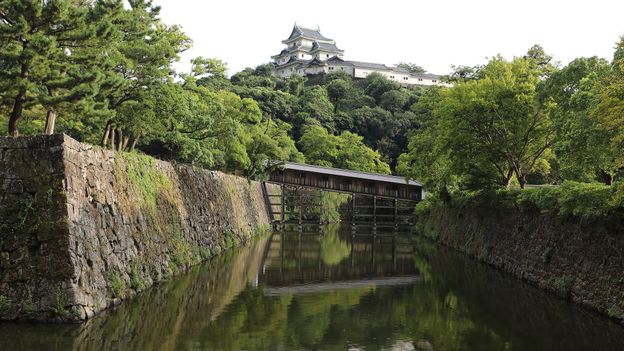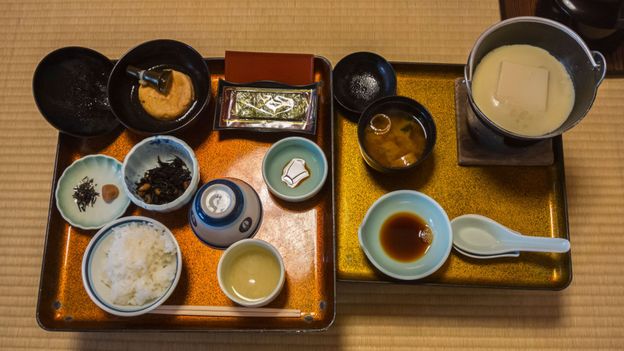
Edged in vibrant pink, a shadow-thin slice of radish sits atop a soft square of sesame tofu. Beside it, a pot of udon simmers gently while a nearby basket holds a nest of crisp tempura – forming just three of the dozen dishes set before me. We are seated in a quiet tatami room at Ekoin, one of more than 100 temples that form the ancient complex of Koya in rural Wakayama prefecture. Perched on the mountainside, the town is the centre of Shingon Buddhism, and our meal is known as shōjin ryōri, a spiritual cuisine perfected by monks over centuries.
Known for its moss-covered cemeteries and forested pilgrimage routes, Koya is home to a long tradition of worship. The town’s many temple lodgings, known as shukubo, offer visitors the chance to experience the ways of Buddhism, from meditation to calligraphy – but few know that the humble temple meals are also an opportunity for spiritual exploration.
Often called “devotion cuisine”, shōjin ryōri was developed by monks, but has recently found its way from temple restaurants to Tokyo’s Michelin-star tables. Both minimal and plentiful, it is often associated with austerity; however, dedicated chefs profess a myriad of visual, technical and seasonal combinations are possible.
Arriving in Japan with Buddhism in the 6th Century, shōjin cuisine was traditionally a simple affair, preserved by hard-working priests and monks, explains Shiten, Ekoin’s resident priest. It was the teachings of 13th-Century writer and Soto Zen school founder, Dogen, however, that pioneered the spiritual focus of the art. Dogen believed that, similar to the practice of flower arranging or tea ceremony, shōjin ryōri had the power to align mind, body and soul.
You may also be interested in:
• Japan’s unknown indigenous cuisine
• A dumpling tracing back to Genghis Khan
• Japan’s most polarising superfood
Dogen’s famed essay, “Tenzo Kyokun”, meaning “Instructions to the Cook”, outlines not only the importance of ingredient selection and balance, but the mindfulness of the chef. The simple dish of goma dofu (sesame tofu) – which requires hours of grinding and stirring – is a well-known example, with the repetitive process demanding a single-minded focus from the chef. Given the lengthy, labour-intensive process and the comparatively brief moment it takes to eat, Shiten considered it the essence of shōjin cuisine, and a lesson in balancing the expectations of the ego.
Shōjin chefs are required to possess the three minds of Japanese Zen Buddhism, known as sanshin, and they become as much a part of the meal as their ingredients. Aishin (the big mind) must be maintained for calmness and motivation; roshin (the parental mind) is needed to respect and care for the ingredients and diner; while kishin (the precious mind) requires the cook to work with pleasure and gratitude.
“Shōjin ryōri literally means ‘food for spiritual practice’,” explained Eric Rath, a professor of Japanese studies and leading expert in Japanese food culture. “Specifically, it refers to a vegetarian meal that also excludes ingredients like garlic and green onion, which Buddhists believed excited the passions,” he continued, outlining the basic rules, of which there are many intricacies and extensions.
It’s a spiritual pursuit, but also it’s an opportunity for you to connect with other people
The guiding concepts of shōjin cuisine are centred on a series of Buddhist precepts, aligning the need for sustenance with religious values such as avoiding harm. “It’s about balance,” explained Mari Fujii, who has taught the cuisine for more than 30 years in the historical seaside city of Kamakura, known for temples, seated Buddhas and ancient political influence. Learning from her husband’s time as a tenzo (the Buddhist chef in a temple or monastery) at a local Kamakura temple, she soon adopted the philosophies into her home cooking: “To be able to fulfil your temple duties, you couldn’t eat too much or too little. It’s about finding the perfect balance, and this comes from the rule of five,” she said.
Drawing significance from the five phases of Chinese Philosophy known as wuxing, the number reflects the cyclical balance needed in nature and society. In shōjin ryōri, this applies to colour, flavour and technique: the goshoku (colour) of white, black, red, green and yellow; the gomi (flavour) of sweet, sour, bitter, salty and umami; and the goho (technique) of simmered, fried, raw, steamed and grilled are all required elements.
As well as guiding nutritional balance, the rules are designed to appeal to the five senses, inspiring the diner to notice and value each ingredient as well as the care taken to prepare it. Before eating even begins, this is done through the chanting of the five Zen reflections, encouraging monks to be grateful, aware of their imperfections, strive to improve upon them, eat for good health and to fulfil their obligations. Passed from chef to diner, the meal forms a bridge, as Fujii explained: “it’s a spiritual pursuit, but also it’s an opportunity for you to connect with other people.”
As vital as the required elements, the restrictions reflect the value of absence that’s recognised in Buddhist training and Japanese aesthetics known as “ma”. The empty space employed in ikebana (Japanese flower arrangement) is equal to the chosen stems, while Dogen initially listed six flavours – counting plain alongside the other five. This preference for subtlety and minimal sacrifice is key, but among Japanese diners who favour meat and the traditional fish-based dashi stock, the cuisine is often viewed as bland and unexciting.
Fujii maintains a boundless enthusiasm for the cuisine’s possibilities, however: “There are so many variations and it is so representative of the seasons, not once in 36 years have I become bored with shōjin ryōri,” she said.
The seasonal aspect of shōjin ryōri is one of its founding principles and offers much of the variety that Fujii adores. Known as shun, this element takes its name from an ancient Japanese counter system and means “10 days”, reflecting a hyper-seasonality still common in Japanese cuisine. Many Japanese restaurants, for example, change menus every few weeks, with fresh decorative leaves adorning plates to highlight the season and daily specials picked out at the market each morning.
One such restaurant, Sougo in Tokyo, is the creation of acclaimed chef Daisuke Nomura. He was head chef when the highly acclaimed, family-run shōjin ryōri restaurant Daigo was awarded two Michelin stars in 2009, and he later struck out on his own to further explore the cuisine’s possibilities.
The most important part of shōjin is consideration and appreciation
“I wanted to work towards a new generation of shōjin ryōri,” he said. “I think dishes should evolve with time, and I wanted the freedom to challenge myself and work with new elements.”
Using the ancient favourite of sesame tofu as an example, he explained how a single change can create a range of new combinations: “Cold, it’s quite limited, but when fried it opens up so many options – I’ve served it with umami sauce, even mashed potato. When I realised the difference one change can make, it inspired me, it really represents what I want to do here at Sougo.”
Nomura embraces the philosophies of shōjin ryōri and has found they are aligned with the growing sustainability focus of restaurants worldwide. Alongside the hyper-seasonal element of shun is an aim to use locally sourced ingredients. Known as shindofuji, the second core concept highlights the need for being in harmony with nature, encouraging the chef to specifically seek what grows around them.
The final pillar, and perhaps the most reflective of the sustainability zeitgeist, is ichimotsu zentai, which means quite literally “to use the whole thing”. Demanding respect, it is a precursor to the zero-waste movement. “The most important part of shōjin is consideration and appreciation,” noted Nomura, “For us to survive, we receive the lives of other things, so we must not waste them.”
This awareness and appreciation has transcended shōjin cuisine to be recognised at the start of all meals in Japanese daily life. Visitors will no doubt have heard the phrase “itadakimasu” uttered before a meal or even a simple snack. Paired with clasped hands and a small bow of the head, the phrase is often translated to mean “I humbly receive” and represents a gratefulness for the food offered and its acceptance. Be it friends enjoying shaved ice in a cafe or family sitting down to a special meal, the phrase is never forgotten and denotes the continued tradition of appreciation founded by shōjin cuisine.
Of course, the shōjin ryōri served in temples and that of Michelin star chefs is somewhat different, as Nomura explained to me: “Shōjin food at temples is designed to support the health of training monks so it doesn’t need to be well-presented. However, at restaurants it’s a meal for customers, so it’s more of an art.” But, he stressed, the core elements remain the same.
Discussing the duality with her London-born sous-chef, Fujii notes a similar realisation in her students’ perceptions, who leave with a new awareness of the spiritual element at the heart of shojin ryōri. “Many arrive thinking about the recipes, but they leave with the realisation that it’s a state of mind, she said. “It’s not just what you do in the kitchen, it’s how you live your life.”
Join more than three million BBC Travel fans by liking us on Facebook, or follow us on Twitter and Instagram.
If you liked this story, sign up for the weekly bbc.com features newsletter called “The Essential List”. A handpicked selection of stories from BBC Future, Culture, Worklife and Travel, delivered to your inbox every Friday.