“Prior to dam removal snorkel surveys of the lower Elwha (2009-11) never revealed more than one or two summer steelhead,” writes NOAA fish biologist Sarah Morley and colleagues in a May 2019 paper. “Sonar [research] estimated the 2018 summer run population to be at least 300 fish. Like the phoenix, summer runs have arisen from the ashes.”
World precedent
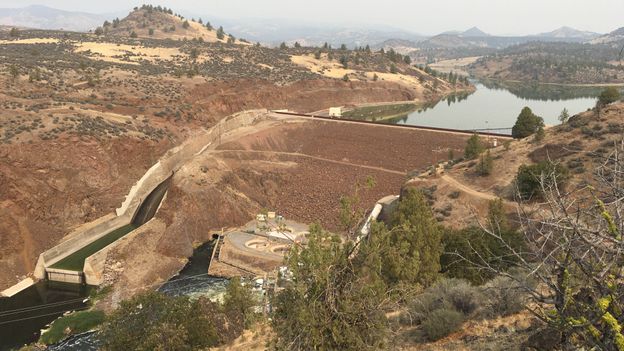
To remove dams as large as those on the Klamath River will be a complex operation. In the Klamath River Renewal Corporation’s plan for the removals, it will start with drawing down the water levels behind each dam wall. Demolition comes next – largely through drilling and blasting, with trucks removing the rubble. The newly exposed reservoir bed is then covered in mulch and indigenous seeds. Not only does this help restore this habitat to its natural state: both will be critical to reduce the amount of sediment washed down to the sea. In experiments conducted by Ellen Mussman and others ahead of the Elwha dam removals, plants reduced erosion by 33%, while mulch reduced it by 99%. Together, these could be a highly effective means to stop erosion, the researchers conclude.
And while it might seem counterintuitive that a power company would be in favour of dam removals, it actually makes good business sense for PacifiCorp. This is because to renew the operating licence for these dams, its ratepayers would have to foot an approximately $400m (£308m) bill for upgrades to ensure compliance with legislation (including the installation of costly fish ladders at each dam that would enable migration).
Removing the dams is a cheaper option: under the Klamath Hydroelectric Settlement Agreement (KHSA), customers will only have to pay $200m (£154m), with an additional $250m (£193m) coming from the State of California. The removals have been endorsed by the Public Utility Commissions of both Oregon and California as being in the interests of ratepayers. Bob Gravely, regional business manager of Pacific Power (the PacifiCorp subsidiary which runs the dams) says that the dam removals “became a better outcome for customers”.
Overall, little will be lost in terms of renewable energy generation: the dams represent less than 8% of PacfiCorp’s 2,208 MW current renewable generation capacity, and as of July 2020 a further 1,190 MW of renewable capacity was under construction. The utility anticipates an additional 3,743MW of renewables coming on stream by the end of 2023.
“I think one of the coolest parts about this whole project is we’re setting a precedent for the world to follow,” says Cordalis. “I think the approach of working together with the company, with states, with tribes, with environmentalists, to reach an agreement that allows these dams to be removed for the tribes and for American citizens to benefit from the restoration of this river in a way that costs less money than it would be to relicense [the dams] – that’s really a model of how you might approach sustainable river restoration across the world.”
The dam removals were slated for 2022, though with negotiations still ongoing between the company, the tribes and other stakeholders, that date is still unconfirmed. But Cordalis says she still remains hopeful. “We’re getting very close,” she says.
“I think we all understand that there is an indigenous tribe [and] a culture at stake,” says Myers. “I think it has held fast in these negotiations that these dam removal efforts are as much to remove the dams for the ecology and benefits of salmon restoration as they are to the wrongs that took place in this country for the last 150, 200 years against Native Americans.”
For the Yurok, Myers says the dams are seen as “monuments to colonialism” and compares them to statues of Confederate generals. “These dams are statues of the war that we fought here on the Klamath River. And these statues destroy our river, the landscape, our culture. We have to deal with them every single day.” In response to this, Pacific Power’s Gravely says: “We are very pleased to be part of a settlement agreement that allows the desire of Klamath Basin Tribes and others for dam removal to move forward” while also ensuring protections for electricity customers in six states.
Myer says the treaty negotiated between Yurok and the federal government in the 1850s limited the tribe to their reservation in return for a good standard of living in perpetuity. Although, he says, the federal government failed to live up to its end of the bargain, dam removals would bring that goal closer.
Anticipating the return of healthy fish runs, the tribe has already built a salmon harvesting plant – both for commercial and subsistence fishing – done sustainably, just as Yurok have done for millennia.
“We have been surviving off the river’s resources and living symbiotically with it since time immemorial,” says Cordalis. “Our creation story talks about how the creator made the river, the land, the animals, the plants, and then made the people and said to the people, ‘This will all be here for you and you won’t want for anything as long as you live in a sustainable way with the natural environment, and as long as you don’t take more than you need to support your family.’ That initial religious principle informs how we interact with the river, how we interact with all of its resources and the natural world.”
While the dams have increasingly threatened this symbiosis, their removal will once more enable the ancient connection between the Yurok people and the Klamath River to flourish.
—
The emissions from travel it took to report this story were 0kg CO2. The digital emissions from this story are an estimated 1.2g to 3.6g CO2 per page view. Find out more about how we calculated this figure here.
—
Join one million Future fans by liking us on Facebook, or follow us on Twitter or Instagram.
If you liked this story, sign up for the weekly bbc.com features newsletter, called “The Essential List”. A handpicked selection of stories from BBC Future, Culture, Worklife, and Travel, delivered to your inbox every Friday.