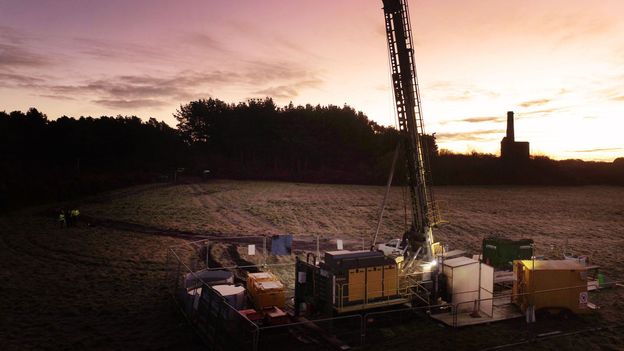
Technological advances are also helping to make it possible to extract lithium from brine. The team is planning to use a technique called Direct Lithium Extraction (DLE), which has been developed by various companies in the US, Germany and New Zealand.
There are as many as 60 variants of DLE technology, according to Jade Cove, a San Francisco-based advisory firm tracking new mining and energy technology. But the basic process involves using techniques such as nanofiltration or ion-exchange resins – which act like a chemical sieve to selectively collect just lithium chloride (the main form in which the lithium is found in the brine), leaving other salts in the water. The lithium chloride is retrieved from the sieve by, for example, washing the resin beads with pure water and injecting the remaining water back into the ground through boreholes. The lithium chloride is then purified and concentrated to produce lithium hydroxide, which is used to make batteries.
But this is not the only way to get lithium from geothermal brine. In the US, William Stringfellow, director of the Ecological Engineering Research Program at Lawrence Berkeley National Laboratory in the US, is undertaking research for the US Department of Energy on the different methods for extracting lithium from brine. One approach is to extract lithium from brines using solvents designed to collect lithium ions, while others include the use of membranes that only allow lithium ions to pass, and electrochemical separation, where lithium ions are drawn to charged electrodes.
“So DLE isn’t necessarily going to be the only technology, but it’s the first one that’s being applied,” says Stringfellow.
Each method has one main stumbling block to navigate – getting only lithium out of the water. “There’s a lot of other materials in the brine that potentially interfere with the lithium extraction process [such as sodium and magnesium], so you have to control those and remove them,” says Stringfellow.
The US and Germany are also hotbeds of research and development on geothermal lithium extraction. The area around the Salton Sea, a shallow lake in the centre of California and the second largest geothermal field in the US, has been dubbed “lithium valley”. The California Energy Commission has estimated that the field could provide 40% of global lithium demand.
In research published in March this year, the commission forecast the region’s lithium carbonate supply at more than 600,000 tonnes a year, which could generate US$7.2bn (£5.3bn) a year at around US$12,000 (£8,885) a tonne. The hope is that lithium extraction could not only provide a cleaner, domestic source of lithium for batteries, but also significantly improve the economics of renewable power production from geothermal resources, which currently produce only 6% of California’s electricity and are expensive to develop.
“Everyone has a lot of stars in their eyes, it’s like a new gold rush,” says Stringfellow. “It is an economically depressed area, so people are very excited about the fact that if they get lithium going, it would lead to an economic boom.”