Future
  • Login
  • Home
  • News
  • Sport
  • Reel
  • Worklife
  • Travel
  • Future
  • Culture
  • More
    • Music
Monday, December 8, 2025

FUTURE

  • Home
  • Future Planet
  • 100 Year Life
  • Best of Future
  • Japan 2020
  • Latest
No Result
View All Result
  • Home
  • Future Planet
  • 100 Year Life
  • Best of Future
  • Japan 2020
  • Latest
No Result
View All Result
Future
No Result
View All Result
Home Future Planet

Can dairy adapt to climate change?

December 16, 2020
in Future Planet
155 10
0
306
SHARES
2.4k
VIEWS
Share on FacebookShare on Twitter

Related articles

How Hong Kong protects people from dangerous landslides

The mystery of Mexico’s vanishing stream oaks


Among this small group of Shropshire farmers, the views on dairy and climate cover much of the spectrum of debate. So how do they make sense of each others’ differing views on climate?

“My uncle Philip is one of the old generation,” Ben says. “He will be retiring soon. I don’t think you can win over people. It’s more about our generation making an impact.” 

Given his knowledge and commitment to reducing climate change, how does Ben respond to critics who argue that we may have to stop eating meat and dairy entirely to make a significant dent in emissions? He pauses. “I think it’s a small minority, who are trying to ruin our future and a business that our family has tried to develop over 100 years. Come to my farm and have a look,” he says. “I can show you what we are doing to reduce our emissions footprint, and all the infrastructure we are investing so heavily in.”

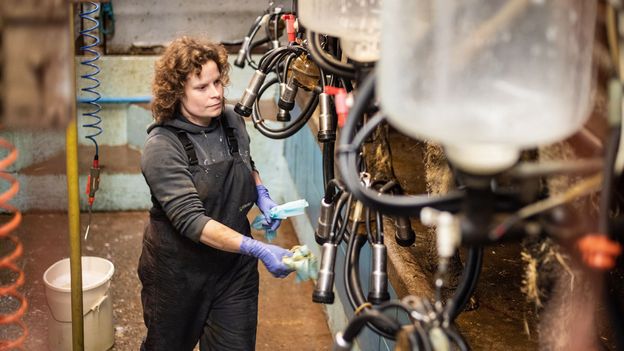
When it’s time to leave, I ask Hannah if hearing from Peter and Ben has changed her perspective. She harbours dreams of renting her own dairy farm with a small herd and setting up an ice cream business. If she is able to realise her ambitions, would she take steps to reduce greenhouse gas emissions?

“I suppose you would have to see the figures, but if we could catch the rainwater to wash the milking parlours and got wind turbines and solar panels to supply electricity, it wouldn’t affect us farmers,” she says. “If there was a way to do our bit and our country did start making steps to improve our emissions, maybe other countries would follow.” But her doubts seem to catch up with her quickly. “But maybe Philip is right? We don’t know who is right and wrong – we don’t know the facts.”

Where Hannah remains unsure about dairy farming’s climate impact, there is another certainty that she will always come back to: her guiding principle.

“Cows are the most important thing. That’s the way I look at it. As long as the cows are happy, we are happy.” 

—

The BBC’s Emily Kasriel is also a practitioner in residence at the London School of Economics’ Marshall Institute, focusing on deep listening. 

—

The emissions from travel it took to report this story were 13kg CO2, travelling by bus, train and car. The digital emissions from this story are an estimated 1.2g to 3.6g CO2 per page view. Find out more about how we calculated this figure here.

—

Join one million Future fans by liking us on Facebook, or follow us on Twitter or Instagram.

If you liked this story, sign up for the weekly bbc.com features newsletter, called “The Essential List”. A handpicked selection of stories from BBC Future, Culture, Worklife, and Travel, delivered to your inbox every Friday.


Source link

Tags: adaptchangeclimatedairy
Previous Post

The end of a fuel worse than coal

Next Post

The world’s fastest-growing source of food

Related Posts

Future Planet

How Hong Kong protects people from dangerous landslides

March 11, 2022
Future Planet

The mystery of Mexico’s vanishing stream oaks

March 9, 2022
Future Planet

Why the Dutch embrace floating homes

February 27, 2022
Future Planet

The animals that detect disasters

February 26, 2022
Future Planet

The tiny islands leading the green transition

February 8, 2022
Future Planet

How Dubai is pushing back its encroaching deserts

February 1, 2022

Leave a Reply Cancel reply

Your email address will not be published. Required fields are marked *

Recommended

The scientists releasing cats in Australia

March 30, 2021

The boomers spending like millennials

June 14, 2020

Popular Post

  • The traditions that could save a nation’s forests

    306 shares
    Share 122 Tweet 77
  • BBC – Travel – Sanbokan: Japan’s rare, sour citrus fruit

    306 shares
    Share 122 Tweet 77
  • The lost generation of ancient trees

    306 shares
    Share 122 Tweet 77
  • The best trees to reduce air pollution

    306 shares
    Share 122 Tweet 77
  • A high-carb diet may explain why Okinawans live so long

    306 shares
    Share 122 Tweet 77
Future

© 2020 JBC - JOOJ Clone ScriptsJOOJ.us.

Navigate Site

  • Home
  • News
  • Sport
  • Reel
  • Worklife
  • Travel
  • Future
  • Culture
  • More

Follow Us

  • Home
  • Future Planet
  • 100 Year Life
  • Best of Future
  • Japan 2020
  • Latest

© 2020 JBC - JOOJ Clone ScriptsJOOJ.us.

Welcome Back!

Login to your account below

Forgotten Password?

Create New Account!

Fill the forms bellow to register

All fields are required. Log In

Retrieve your password

Please enter your username or email address to reset your password.

Log In
Future
More Sites

    MORE

  • Home
  • News
  • Sport
  • Reel
  • Worklife
  • Travel
  • Future
  • Culture
  • More
    • Music
  • Future

    JBC Future