

Tehuty News
  • Login
  • Home
  • News
  • Sport
  • Reel
  • World

    Huge anti-government protests in Tehran and other Iranian cities, videos show

    Trump calls for US military spending to rise more than 50% to $1.5tn

    The painful questions for Nato and the EU if Trump takes Greenland

    South Korea’s Lee Jae Myung seeks ‘new phase’ in ties with China at Xi Jinping meeting

    Trump warns new Venezuelan leader as Maduro set to appear in court

    Venezuelans react to US Maduro arrest with hope and uncertainty

    Four challenges facing New York City Mayor Zohran Mamdani

    Six killed in clashes between protesters and security forces in Iran

    Disney World cast member hurt stopping 180-kg fake boulder from hitting audience

  • Worklife
  • Travel
  • Future
  • More
    • Culture
    • Music
10 °c
London
15 ° Thu
16 ° Fri
8 ° Sat
7 ° Sun
No Result
View All Result

Welcome to Tehuty News

Friday, January 9, 2026
Tehuty News
  • Home
  • News
  • Sport
  • Reel
  • World

    Huge anti-government protests in Tehran and other Iranian cities, videos show

    Trump calls for US military spending to rise more than 50% to $1.5tn

    The painful questions for Nato and the EU if Trump takes Greenland

    South Korea’s Lee Jae Myung seeks ‘new phase’ in ties with China at Xi Jinping meeting

    Trump warns new Venezuelan leader as Maduro set to appear in court

    Venezuelans react to US Maduro arrest with hope and uncertainty

    Four challenges facing New York City Mayor Zohran Mamdani

    Six killed in clashes between protesters and security forces in Iran

    Disney World cast member hurt stopping 180-kg fake boulder from hitting audience

  • Worklife
  • Travel
  • Future
  • More
    • Culture
    • Music
No Result
View All Result
Tehuty News
No Result
View All Result
Home Technology

Technology in 2050 – experts give their predictions

January 3, 2026
in Technology
12 min read
303 20
0
351
SHARES
1.4k
VIEWS
Share on FacebookShare on Twitter


Laura CressTechnology reporter
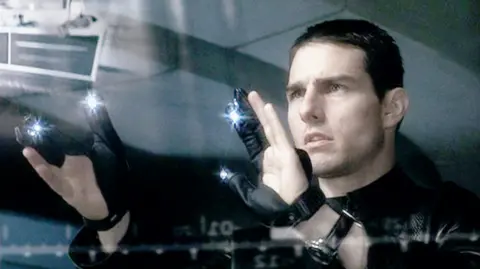
CBS Photo Archive Scene from the film Minority Report. A man (the actor Tom Cruise in the film Minority Report) stares at a transparent screen, wearing black gloves with bright lights on them. CBS Photo Archive

The 2000 film Minority Report, set in 2054, imagined potential future technologies like controlling computers by making hand gestures

The last 25 years has seen some mind-bending technological changes.

At the start of the century, most computers connected to the internet with noisy dial-up connections, Netflix was an online DVD rental company, and the vast majority of people hadn’t even heard of a smartphone.

Fast forward two and a half decades, and innovations in AI, robotics and much else besides are emerging at an incredible rate.

So we decided to ask experts what the next 25 years could bring.

Here are their predictions for the technology we’ll be using by 2050 – and how it could reshape our lives.

Merging humans and machines

Science fiction set in the 2050s is full of examples of humans using technological enhancements to feel fitter, happier and more productive.

In the 2000 hit game Deus Ex – set in 2052 – the player can inject themselves with tiny robots called “nanites”.

These microscopic robots manipulate matter on atomic levels, giving superhuman abilities such as enhanced speed and the ability to see in the dark.

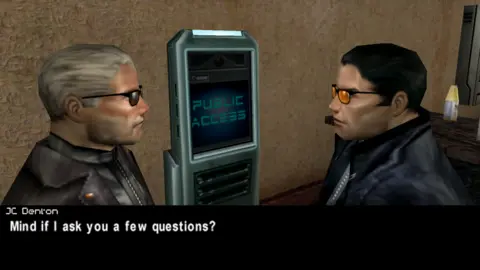
Eidos A screenshot from the video game Deus Ex. Two men in the game are staring at each other, in front of a machine with the words Eidos

In the video game Deus Ex, the protagonist – who enhances his abilities with augmentations – investigates a global conspiracy involving a terrorist group and secret societies

It sounds like something from the distant future, but nanotechnology – engineering at a scale of millionths of a millimetre – is already used in lots of everyday real-life tech.

In fact, it is powering the way you are reading these very words right now – every smartphone or computer is run by a central chip made up of billions of tiny transistors – electrical components built on a nanoscale to speed up data processing.

Professor Steven Bramwell at the London Centre for Nanotechnology told the BBC by 2050 we should expect the lines between machines, electronics and biology to be “significantly blurred”.

That means we could see nanotechnology implants by then – but more to “monitor your health or aid communication” rather than to appear invisible, as in Deus Ex.

Medicine could also make common use of machines at a nanometre scale to “deliver drugs to exactly where they need to go”, said Professor Bramwell.

Cybernetics professor Kevin Warwick is equally interested in studying augmentations, going one step further than most.

In 1998 he became the first human to have a microchip implanted into his nervous system, earning him the title “Captain Cyborg”.

Professor Warwick believes by 2050, advancements in cybernetics – the science studying the links between natural and mechanical systems – could lead to trailblazing treatments for diseases.
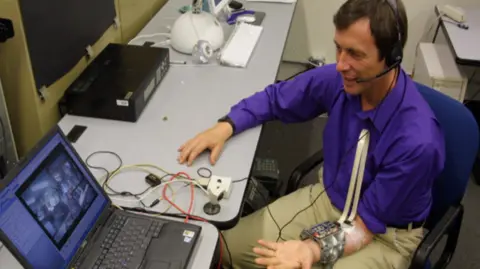
Kevin Warwick A man sitting down with a headset and wearing a purple shirt has his hand helf out in front of him, around his arm is a metal chip bracelet. He is looking at an open laptop screen.Kevin Warwick

Professor Warwick has undertaken several pioneering experiments with the chip, including controlling a robot arm across the Atlantic Ocean using only his brain.

He predicts the use of “deep brain electronic stimulation” as a partial treatment for some conditions such as schizophrenia, rather than medicine.

He adds it is likely we’ll see more cybernetic enhancements of the kind he has already trialled himself, so that “your brain and body can be in different places”.

And what if we wanted to test out how the latest enhancement, or even new diet worked on our bodies, without any risks of experiencing the side effects?

Professor Roger Highfield, director of the Science Museum Group believes “digital twins” – virtual versions of a physical object, updated using real time data – could become a regular feature in our lives.

He imagines a world where each of us could have “thousands of simplified twins”, using them to explore how “different medications or lifestyle changes affect your unique biology”.

In other words, we could preview our futures before we live them.

The next generation of AI

Many technology firms, including Google and IBM, are currently locked in a multi-billion dollar race to revolutionise how we push fields like AI even further – in the form of quantum computing.

Quantum computers are machines which can do very complex calculations at incredibly fast speeds – for example, simulating molecular interactions to design new drugs faster.

In January 2025, Jensen Huang – boss of the leading chip firm Nvidia – said he believed “very useful” quantum computing would come in 20 years.

AI itself will undoubtedly continue to loom large in our society as we journey towards the half century mark.

Futurist and author Tracey Follows, who helped write a government White Paper on UK education in 2050, believes learning will take place across “virtual and physical realities” using AI teachers which “adjust in real time”.

Rather than textbooks, she predicts children will use “immersive simulations”.

Meanwhile, education will be less standardised, with each child’s individual DNA or biometric data studied to understand how they learn best.

Traffic-free roads and lunar bases
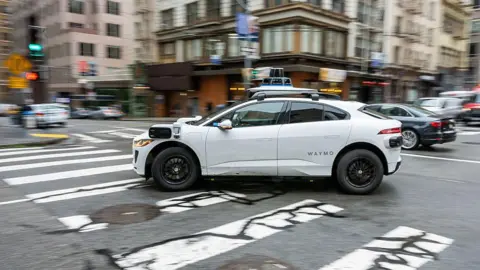
Bloomberg A white Waymo autonomous taxi driving down the road.Bloomberg

Waymo is a company developing autonomous driving technology

The writer Bill Douglass is well-versed in making compelling forecasts – in 2000 he won a $20,000 (£14,800) global futurist writing contest entitled “The World in 2050”.

While he still agrees one of his original predictions – pilotless planes – will come true by 2050, he believes we will first see more advances in driverless cars, making traffic congestion “largely a thing of the past”.

“Cars will drive so much closer to each other than they can now,” he told the BBC. “And if one has to break, they all break.

“On private toll roads for autonomous vehicles, there’s no reason traffic can’t go up to 100 miles an hour or so – you’ll see mortality from traffic accidents plummet.”

Away from Earth, the space race will equally continue at speed, journalist and co-host of the Space Boffins podcast Sue Nelson told the BBC.

She says in 25 years, it is likely there will be a liveable base on the Moon; and some industries could be almost entirely based in space.

For example, she believes we may see pharmaceutical companies making the next generation of medicines in microgravity, i.e. on board an orbiting spacecraft.

This is because, she says, crystals grown this way rather than on Earth, are “often larger and better quality”.

Sci-fi meets science

The film Minority Report, based on a novella by science fiction author Philip K Dick, was released in 2002 and set in the year 2054.

Three years before production began, director Steven Spielberg invited fifteen experts, including the founder of virtual reality Jaron Lanier, to a three-day summit to reflect on which technologies could possibly exist in the 2050s.

The discussions shaped many of the innovations featured in the film.

If the events of the Tom Cruise-starring science fiction thriller are to be believed, by the mid-2050s we will all be using gesture recognition (and fancy gloves) to swirl through videos on our transparent monitors, while policemen on jetpacks fight impending crime with the help of vomit-inducing batons.

Like much science fiction in the arts, the film paints a dystopian view of our future years.

It’s a feeling which some experts have begun to echo in our current timeline – with some going even as far as to suggest that artificial intelligence could lead to the extinction of humanity.

Perhaps before getting too despondent about what may await us in 2050, it’s worth returning to the words of Philip K Dick himself.

“I, for one, bet on science as helping us,” he wrote in his 1968 personal autobiographical essay Self Portrait.

“Science has given us more lives than it has taken,” he said.

“We must remember that.”

A green promotional banner with black squares and rectangles forming pixels, moving in from the right. The text says: “Tech Decoded: The world’s biggest tech news in your inbox every Monday.”


Source link

Related posts

Workers cling to the software despite shift to AI

January 9, 2026

Inside the sub-zero lair of the world’s most powerful quantum computer

January 8, 2026
Previous Post

I lecture Stirling University nursing students about my dementia

Next Post

#fypシ #fypシ゚viral #fyp #viralvlog #reelsfb #reel #reelsvideo #home #funny #songs #love #yt #bbc

Next Post

#fypシ #fypシ゚viral #fyp #viralvlog #reelsfb #reel #reelsvideo #home #funny #songs #love #yt #bbc

Leave a Reply Cancel reply

Your email address will not be published. Required fields are marked *

RECOMMENDED NEWS

TikTok sued for ‘massive’ invasion of child privacy

1 year ago

Oil production to drop after Opec+ nations meet

3 years ago

COP26: Scotland’s young climate change activists in pictures

4 years ago

Can ‘good cop’ Janet Yellen help fix US-China relations?

3 years ago

FOLLOW US

  • 138 Followers
  • 79.6k Followers
  • 207k Subscribers

BROWSE BY CATEGORIES

  • Business
  • Have your say
  • In Pictures
  • Politics
  • Reel
  • Sports
  • Technology
  • Top News
  • World

BROWSE BY TOPICS

America animation B.B.C. bbc B B Ci Player BBC iPlayer bbcnews BBC NEWS bbcreel BBC Reel breaking news British TV british tv shows documentaire documental documentaries documentary documentary film facts factual features free documentary full documentary funny History india India news iPlayer music NEWS physics reel science Streaming top documentaries TV United Kingdom usa us news Video watch british tv online watch british tv shows online watch uk tv online World world news

Top Stories

  • Who owns Thames Water and why is it in so much trouble?

    352 shares
    Share 141 Tweet 88
  • Hungary v England: Fifa investigating racial abuse aimed at players at Puskas Arena

    355 shares
    Share 142 Tweet 89
  • Gabriel Martinelli: Arne Slot defends Arsenal winger

    351 shares
    Share 140 Tweet 88
  • Workers cling to the software despite shift to AI

    351 shares
    Share 140 Tweet 88
  • Storm Goretti brings 99mph winds and snow as 65,000 properties lose power

    351 shares
    Share 140 Tweet 88

Features

Business

More businesses call to be included in pub rates backtrack

by admin
January 9, 2026
0

High street shops, pharmacies and music venues have called on Rachel Reeves to axe the looming increases to business...

Read more

Russia Targets Odesa Port | Ukraine’s Lifeline at Risk #shorts

January 9, 2026

Workers cling to the software despite shift to AI

January 9, 2026

Storm Goretti brings 99mph winds and snow as 65,000 properties lose power

January 9, 2026

Huge anti-government protests in Tehran and other Iranian cities, videos show

January 9, 2026

Recent News

  • More businesses call to be included in pub rates backtrack
  • Russia Targets Odesa Port | Ukraine’s Lifeline at Risk #shorts
  • Workers cling to the software despite shift to AI
Tehuty News

Breaking news, sport, TV, radio and a whole lot more.
Tehuty News, educates and entertains - wherever you are, whatever your age.

Follow us on social media:

Category

  • Business
  • Have your say
  • In Pictures
  • Politics
  • Reel
  • Sports
  • Technology
  • Top News
  • World
  •    If you re feeling guilty  there s probably a reason   Watch Love Life on iPlayer   LoveLife  bbciplayer  iplayer
  • When a series of disturbing incidents plagues an insular fishing community  a young man must wrestle with something entirely unexpected      Watch The Terror  Infamy on iPlayer from tonight at 9pm    TheTerrorInfamy  theterror  bbciplayer  iplayer  drama  horror  supernatural
  •  thebodycoach explores how his parents    mental health struggles shaped him in a new documentary  executive produced by  officiallouistheroux  Watch Joe Wicks  Facing My Childhood on iPlayer from 16 May  If you  or someone you know  has been affected by any of the issues in Joe Wicks  Facing My Childhood  the following organisations may be able to help  https   bbc in 3LPZ5xI   JoeWicksFacingMyChildhood  bbciplayer  iplayer  MentalHealth  JoeWicks  TheBodyCoach
  • Ten Dancers  One Iconic Stage     Who will be crowned BBC Young Dancer 2022   BBC Young Dancer  The Final  Saturday 7 May at 7pm  bbctwo  Series catch up on  bbciplayer   bbc  bbcarts  arts  dance  dancing  dancer  dancers  youngdancer  youngdancer2022  bbcyoungdancer2022
  • Election 2022  What does it all mean  Laura Kuenssberg and Chris Mason discuss  Newcast   Listen on BBC Sounds
  • Five home bakers compete in a national competition to create a pudding fit for the Queen  hoping to be crowned winner of the jubilee pudding           Watch The Jubilee Pudding  70 Years in the Baking on iPlayer from 12 May   bbc  bbciplayer  jubilee  platinumjubilee  royalfamily  thequeen  jubileepudding
  • The one and only Polly Gray  forever in our hearts and minds          Watch Peaky Blinders on iPlayer   PeakyBlinders  PollyGray  iPlayer  BBCiPlayer    Drama
  • Accurate depiction of dating in your thirties     Watch Gentleman Jack on iPlayer   GentlemanJack  bbciplayer  iplayer  dating
  • What s a jazz album you think people should check out         gregoryportermusic   palomafaith and  yolandabrown have each recommended a great jazz record for you to try

Recent News

More businesses call to be included in pub rates backtrack

January 9, 2026

Russia Targets Odesa Port | Ukraine’s Lifeline at Risk #shorts

January 9, 2026
  • Home
  • News
  • Sport
  • Reel
  • World
  • Worklife
  • Travel
  • Future
  • More

© 2020 Tehuty News

  • Home
  • News
  • Sport
  • Reel
  • Travel
  • WorkLife
  • Future
  • World
  • Technology
  • Login

© 2020 Tehuty News

Welcome Back!

Login to your account below

Forgotten Password?

Create New Account!

Fill the forms bellow to register

All fields are required. Log In

Retrieve your password

Please enter your username or email address to reset your password.

Log In