



It’s 16:00 near lake La Cocha in Colombia’s southern department of Nariño, and the kitchen staff at Naturalia are busy at work. Long light rays of an overcast afternoon mingle with smoke wafting in from the trout being prepared in the scullery next door. Indigenous Colombian chef and environmentalist Anibal Jose Criollo presides over the team inside the humble cabin, pausing to greet a neighbour delivering a basket of fruit while his six-year-old niece Helen sits in a corner, playfully sifting blackberries.
50 Reasons to Love the World – 2021
Why do you love the world?
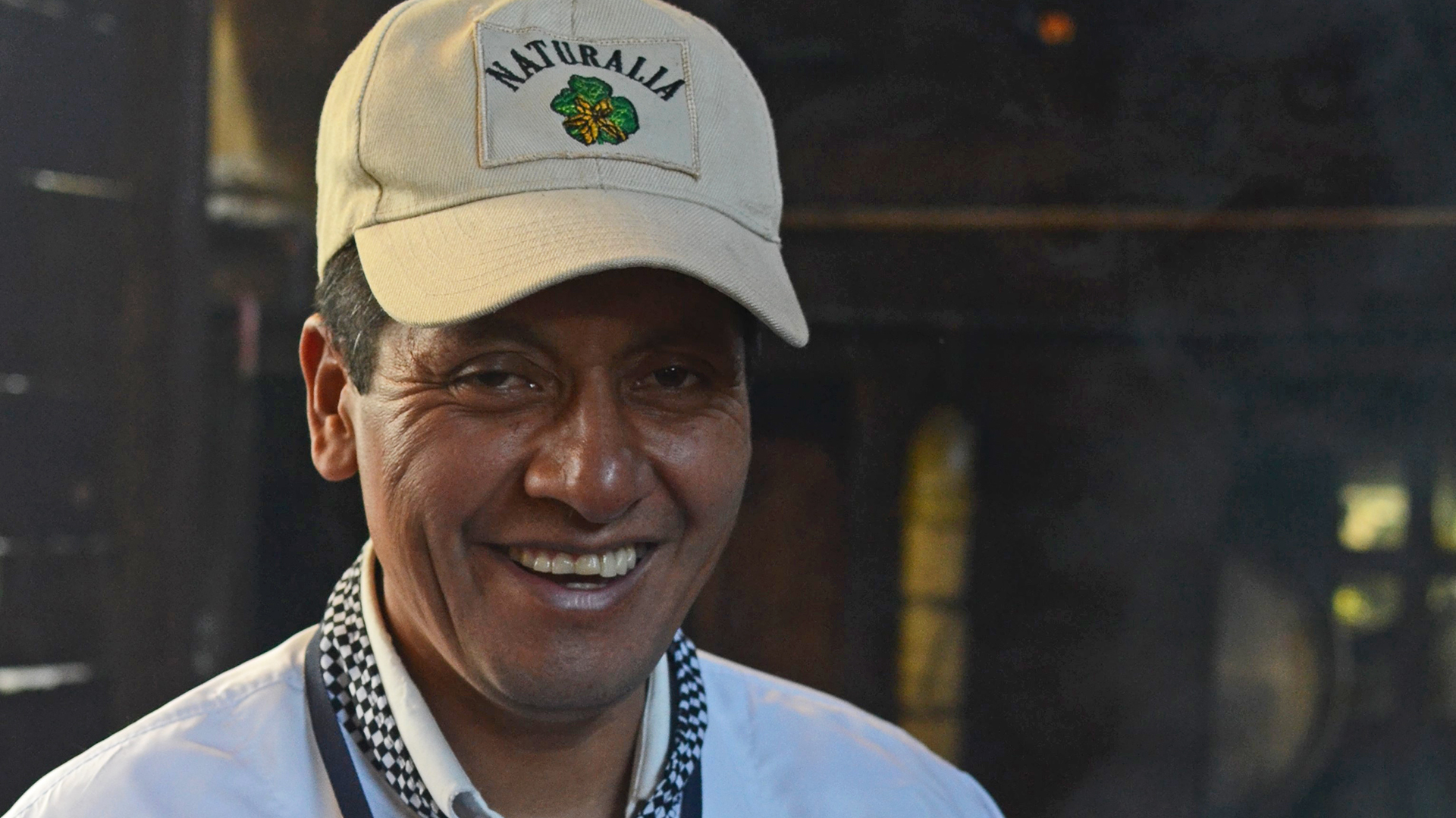
“Because there is a lovely moment when the potato or the arracacha is ready to be harvested and you go past in the morning or at night, and you have the smell of the flowers, and they are special because when they don’t have pesticides this aroma leaves you wanting to stay there.” – Anibal Jose Criollo, chef and environmentalist
Between stoves and an immense square table in the middle of the cabin’s creaky wooden centre, Criollo prepares a mix of local and ancient specialities – herido de frutas rojas silvestres (a warmed alcoholic drink made with a mix of wild red berries), trucha ahumada (smoked trout) from the lake, quinoa arepas and a pork caldo (broth) from a pig that formerly resided in Criollo’s shagra (an ancestral indigenous food garden).
This region of Colombia, with its cool climate and high-altitude plains, is known for being different to the rest of the nation, culturally far closer to other Andean countries like Bolivia, Peru and Ecuador, which it borders. Here in the furthest reaches of the Incan empire, the Pasto indigenous people stood firm against Emperor Huayna Cápac, leading him to give them the name “past awá” or “people of the scorpion” because he supposedly said he “wanted to step on their heads and they bit me with their tail”.
After resisting the Incan imperial advances, the Pastos were later overwhelmed by the Spanish colonial invasion and successive waves of Catholic missionaries.
“[The Spanish] took away our culture… and in the process annihilated us,” said Criollo. “But one thing they cannot annihilate is the feeling of ownership of a territory, and that attribute of the territory which is food.”
Today, Pasto communities still live in what is now Ecuador and southern Colombia, and they are still fighting to maintain their cultures, which is epitomised by the philosophy of Buen Vivir (“Living Well”).
“Buen Vivir in a few words, is learning to value myself as a human being… learning to value the other and learning to value and care for the environment in which one develops themselves,” said Criollo.
Buen Vivir is a pluralistic worldview that’s prevalent among indigenous communities across Latin America
Buen Vivir is a pluralistic worldview that’s prevalent among indigenous communities across Latin America and whose principles are shared by different cultures around the world. Similar to the concept of ubuntu from South Africa, it holds that an individual’s wellbeing can only be achieved through harmonious relationships with the wider community – including people, the environment, other living beings, their ancestors and the cosmos. Practically speaking, it encompasses themes like food sovereignty, land rights, environmental justice, economic solidarity and the protection of local biodiversity.
According to Criollo and other environmental activists, in an era of coronavirus and climate crisis uncertainty, there has been a global awakening that our way of life need to become less individualistic and more sustainable. Now, the guiding social and environmental principles of Buen Vivir are being considered by outside communities.
The philosophy resonated powerfully for Criollo when his restaurant Naturalia closed for seven months during the Covid-19 lockdown. Without his primary income, Criollo sustained his family and himself by growing broad beans, potatoes and arracacha (an Andean vegetable that resembles a cross between a carrot and celery root), among other crops in his shagra. He also made yoghurt from his cows and traded with others in his community through a cooperative-sharing system called mindala.
You may also be interested in:
• The chef preserving Canada’s indigenous identity
• Michael Pollan talks about food and identity
• The indigenous communities that predicted Covid-19
Fellow Pasto Nancy Margoth Estación Puenayan is part of the Shagreros of Panam Association, whose 26 participating families use their shagra gardens to cultivate traditional seed varieties through growing food and medicinal plants. Puenayan describes the mindala system as, “the things that we don’t consume ourselves we share, also sharing knowledge about planting and gastronomy.”
The UN’s Food and Agriculture Association worked in the Nariño department with Pasto communities like Puenayan’s and in 2013 prepared the Mindala and Shagra guide, showing to outside communities the viability of these ancestral models to construct and promote autonomy, sovereignty, security and biodiversity.
Protecting the environment is also a central mission for the Shagreros of Panam Association, and in 2018 it won an award from the Nariño government, in conjunction with the Global Environment Facility and United Nations Development Program, for its work in planting native trees which helped to protect the area’s water sources.
If I plant a tree, it then takes care of me. It provides me with seeds, it gives me water, clean air
“If I plant a tree, it then takes care of me. It provides me with seeds, it gives me water, clean air. Each tree is an ecosystem, one supporting insects and biodiversity,” said Criollo, who also works with neighbouring families to reforest areas with native plant species. Working with indigenous and peasant farming families, he has helped to ensure that La Cocha lake – which is considered sacred to indigenous communities – received Ramsar status as a protected wetland, and expanded the area’s network of around 100 civil society nature reserves – a Colombian conservation model where private individuals devote part of their land to environmental protection.
“What are we connecting? Conservation, clean food production, caring for seeds and looking at culture through the lens of food,” said Criollo. And with Covid-19, this interconnectedness has enabled many more people to revaluate their relationship with the planet.
“One of the impacts of the pandemic has been to work towards integral health, highlighting the importance of recuperating the balance between man and nature,” said Luis Eduardo Calpa, who works with the Basque Mundukide Foundation to support Criollo and Puenayan by promoting agroecology, community self-management and responsible consumption by connecting small-scale producers with traditional chefs. “Now the proposal of the indigenous communities has much more validity,” Calpa added.
Like other indigenous communities, the Pastos’ traditional ways of life have historically been marginalised, first by Spanish colonialists and then by indifferent national governments. But Colombia’s 1991 Constitution recognised indigenous people’s rights to their own territories and legal and economic systems. Additionally, Colombia’s Constitutional Court’s jurisprudence notes how indigenous land is not only the basis for subsistence, but it is also a living entity that is intimately entwined with indigenous communities’ cultural and spiritual practices.
Now indigenous and farming communities in southern Colombia are increasingly mobilising to grow healthy food, promote supportive local economies, use ancestral seeds and protect the environment, with shagras and the mindala system forming the cornerstones of this revival.
Alba Portillo is the founder and coordinator of the local Guardians of the Seed Network, which currently shares and cultivates more than 2,500 traditional, heirloom and non-genetically modified food species with rural farmers and urban consumers. She says seeds are a sacred part of understanding Buen Vivir, and that the spiritual relationship people have with food is nurtured through cultivating and caring for what you eat.
Portillo says that a large part of what the network does is to fight the crisis brought about by big agriculture that relies on chemical fertilisers, herbicides, pesticides and genetically modified seeds instead of those whose unique traits were carefully bred over thousands of years.
“We have lost more than 80% of our agro-biodiversity, which means for each one gone, we have lost a story, an inheritance, an identity in the territory,” said Portillo.
The philosophy of Buen Vivir is also gaining wider recognition among non-indigenous Colombians. In November 2020, the Colombian government created a Buen Vivir fund to finance entrepreneurial projects in indigenous communities. Last May, the ground-breaking documentary series El Buen Vivir (“The Good Life”) launched on YouTube and Colombian television. The series showcased how nine Colombian indigenous communities incorporate, live and embody the concepts of Buen Vivir, with each film created and directed by indigenous filmmakers.
And while Colombia is regularly ranked by Gallup as one of the happiest countries in the world, Buen Vivir researcher Martin Calisto Friant, says this seems to speak more about how people there have strong community and family structures and are not dependent on the state or a capitalistic market.
The land nourishes us, it feeds us, it teaches us, it takes care of us, and so we leave it as our inheritance for the next generations
In a research paper, Fraint notes that Buen Vivir is the opposite of capitalistic consumerism. Those who follow it aspire for a democratic society where happiness is not bound by material accumulation. It focuses on solidarity, reciprocity and citizenship, thus sharing many elements with recent concepts like degrowth and slow economy.
In Friant’s native Ecuador, the government of former president Rafael Correa took radical steps to popularise the principles of Buen Vivir, making it a fundamental pillar of the country’s new 2008 constitution and creating a short-lived secretariat in 2013 to support its implementation. Further afield, countries like Iceland, New Zealand and Scotland are exploring alternative indicators to GDP to measure citizen wellness. For decades, the mountain kingdom of Bhutan has used Gross National Happiness (GNH), integrating a mix of spiritual and social markers to measure its citizens’ wellbeing.
Most recently, on 2 February 2021, the landmark Dasgupta Review on the Economics of Biodiversity was released. Commissioned by the UK Treasury in 2019, the report calls for a transformational change in our economic approach to nature and proposes recognising nature as an asset and reconsidering our measures of economic prosperity.
Back outside in his shagra, Criollo walks with his niece Helen, showing her how the scraps from the kitchen get fed to earthworms or pigs. Helen squeals with joy as she holds a cuy (guinea pig), a local regional delicacy, and collects eggs from under a cackling hen.
“This is an education you can’t find in schools,” said Criollo, who believes that the most important part of Buen Vivir is that it is intergenerational. “The land nourishes us, it feeds us, it teaches us, it takes care of us, and so we leave it as our inheritance for the next generations.”
BBC Travel celebrates 50 Reasons to Love the World in 2021, through the inspiration of well-known voices as well as unsung heroes in local communities around the globe.
—
Join more than three million BBC Travel fans by liking us on Facebook, or follow us on Twitter and Instagram.
If you liked this story, sign up for the weekly bbc.com features newsletter called “The Essential List”. A handpicked selection of stories from BBC Future, Culture, Worklife and Travel, delivered to your inbox every Friday.