





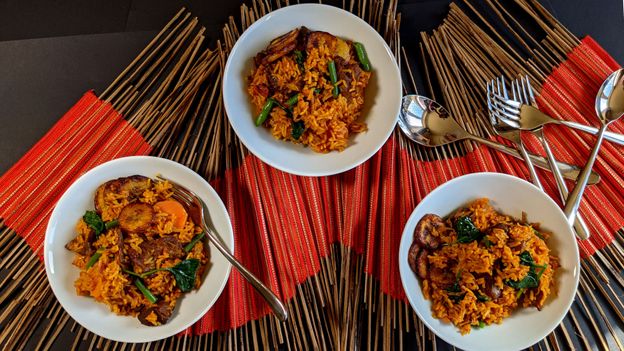
With its seductive aroma, deep-red colour and spicy flavour, Jollof rice is the undisputed queen of West African kitchens. It’s our beloved culinary treasure and a dish from our very heart and soul. But just whisper the word “Jollof” in West Africa and you could easily start a fiery feud of passion. That’s because determining which West African nation makes Jollof best is an ongoing matter of local pride and contention.
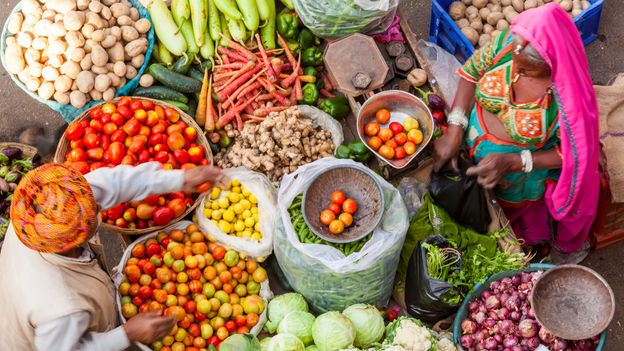
Jollof rice is to West Africa what paella is to Spain, risotto to Italy, biriyani to India and fried rice to China. As a child growing up in Ghana, I gobbled Jollof down at family gatherings, birthdays, coming-of-age ceremonies, engagement parties and weddings. Enjoyed as a main meal, this rich, mouth-watering dish consists of rice cooked in a flavourful sauce of tomatoes, onions and aromatic spices. These base ingredients are often layered with ginger, garlic, thyme, grains of selim (a West African spice), tomato puree, curry powder and Scotch bonnet chillies, though the exact components and preparation differ from country to country; even from house to house.
While each plate of Jollof may vary, every one brings exciting flavours. The savoury sweetness of onions is very important. Seasoning is crucial. And the choice of meat – mutton, beef, chicken, goat, lamb or even fish – delivers a different deliciousness every time. The meat is spiced and delicately braised in stock until tender, before being fried and returned to the stock. Then the rice is added to the meat, stock and spicy sauce and simmered until it absorbs all the flavoursome liquid, leaving every grain aromatic, delectable and a luscious orangey-red hue.
You may also be interested in:
• Asia’s contentious rice dish
• Can Rwanda’s milk bars survive?
• Did the Dutch steal this ‘superfood’?
The origins of Jollof rice can be traced to the 1300s in the ancient Wolof Empire (also called the Jolof Empire), which spanned parts of today’s Senegal, The Gambia and Mauritania. Rice farming flourished in this region, and Jollof began life as a dish called thieboudienne, prepared with rice, fish, shellfish and vegetables. As the empire grew, the Wolof people dispersed across the region and settled in different parts of West Africa, taking their sumptuous rice dish with them.
Despite its ubiquity across the region, few foods have caused as much of a stir as Jollof rice. Today, every West African country has at least one variation of Jollof, which both divides and unites the region. Each nation and family add their own twist and interpretation, which perhaps is the root of the fierce competition taking place across social media, parties and street-side chats. Black Foodie website, which explores food and culture through a black lens, described it as “one of the most interesting and heated food debates amongst the diaspora… it’s the most epic food beefs of all time.”
The main protagonists in a steam over who makes the best Jollof rice are Ghana, Nigeria, Sierra Leone, Liberia and Cameroon. The Gambia and Senegal are quite laid-back and rarely enter the Jollof controversy; after all, they gave it to the world. Myriad variations fuel the ongoing competition with as many similarities as there are differences; and with oral traditions of passing down recipes, what else could be expected?
For instance, my Ghanaian mother would stew the rice with the sauce and meat in a one-pot dish, which is, of course, my favoured preparation. Nigerians and Liberians sometimes use palm oil instead of vegetable oil to give a richer depth of flavour, especially when cooking with smoked and dried fish. In Nigeria and Cameroon, red peppers are often blended with the base ingredients of onions, tomatoes and chilli to add vibrancy and a subtle sweetness. These two nations also like to add smoked paprika to give Jollof a smoky flavour, similar to cooking over an open wood fire. A Gambian friend boasts of adding smoked snails to her Jollof, a traditional ingredient in The Gambia and Senegal.
Nigerian food writer Jiji Majiri Ugboma believes that “the Jollof feud between Ghana and Nigeria is arguably the most heated food debate amongst any diaspora”. As a Ghanaian with many Nigerian friends, I couldn’t agree more. These two passionate nations seem to love to hate each other, and both feel theirs is the best Jollof rice. One main difference is the type of rice used. Ghanaians use aromatic basmati rice, which gives it extra flavour, while Nigerians use long grain rice, believing that it is best for absorbing flavour. Both countries enjoy this gentle teasing, seeing it as a battle of wits where each tries to wear the other down with words.
“Ironically, the feud actually brings Nigerians and Ghanaians together,” Ugboma said. “It is a love language between both countries and is similar to the dynamic of siblings teasing each other.”
The Jollof feud between Ghana and Nigeria is arguably the most heated food debate amongst any diaspora
Musicians have joined in the banter too, with Akon claiming Liberian Jollof is the best, even though he’s from Senegal. Ghanaian musician Sister Deborah released an anthem in 2016 called Ghana Jollof with lyrics including “Ghana Jollof, yummy; Nigerian Jollof, it is funny”.
Senegalese chef Pierre Thiam, who owns Teranga restaurant in New York City, believes that this banter is both “playful and really serious”.
“I wish all wars were fought like the Jollof war. No killings! No blood,” he said. “I also believe that there will never be a winner. Everyone thinks that their mother makes the best. I enjoy both the Nigerian and the Ghanaian and even the Sierra Leonian Jollof dishes, but in my humble opinion, nothing compares to the original one: Senegal Jollof.”
As much as West Africans enjoy these good-natured differences of opinion, there’s no doubt our love for the dish can bring us together. It’s easy to understand why all hell broke loose when celebrity chef Jamie Oliver cooked Jollof rice and shared his recipe on his website in 2014. West Africans forgot that they had a Jollof war going on. Outraged, their collective response was to drop everything, hold hands and charge for Oliver’s website. They may have been arguing over whose Jollof was best in West Africa, but they were not going to allow anyone to mess with their culinary treasure. Hashtags like #jollofgate were unleashed on Twitter. With ingredients including lemon, coriander and parsley, Oliver’s Jollof was for many a twist too far, even though he stressed that his recipe was his own take on Jollof. Africans were concerned that if this went unchallenged, cultural misappropriation could quite easily make Oliver’s version the official Jollof rice.
Yet, by and large, the Jollof debate has been positive and has increased awareness of and interest in West African food. The top 10 fastest-growing food trends for 2020 predicted by Whole Foods included food from West Africa: peanuts, lemongrass and ginger; grains like teff, sorghum, fonio and millet; and the superfood moringa were all mentioned as traditional West African flavours that “are popping up everywhere in food and in beverage”.
And, as if an awakening in the diaspora, Jollof is suddenly everywhere too. Jollof food festivals have been held in Washington, DC, and Toronto, and Jollof competitions in Nigeria. World Jollof Day has been celebrated every year, on 22 August, since 2015, with photographs and videos unleashed on social media.
As African restaurants around the world become ever more mainstream, they are adding even more variations and interpretations to their Jollof offerings. London’s Ikoyi dishes up smoked Jollof rice with crab custard; while Teranga’s Jollof rice finds new form in an “Ancient Vegan Bowl”, topped with a sweet potato and black-eyed peas stew, a kale and organic red palm fruit oil stew, and spicy plantains.
With the increase in Jollof’s global popularity, Thiam believes that “We will see a growing interest for the dish and for African foods in general. Watch out for Jollof rice in your supermarket aisle.”
As excited as we are about the world embracing Jollof rice, for West Africans, it is more than a colourful and tasty rice dish we enjoy arguing over: it connects to our rich heritage and is a dish that will forever remain in our hearts. Even as we draw closer together, the fire in the Jollof kitchen rages on.
Food Wars is a series from BBC Travel that invites you to feel the heat when passions flare around beloved dishes that shape a culture’s identity.
Join more than three million BBC Travel fans by liking us on Facebook, or follow us on Twitter and Instagram.
If you liked this story, sign up for the weekly bbc.com features newsletter called “The Essential List”. A handpicked selection of stories from BBC Future, Culture, Worklife and Travel, delivered to your inbox every Friday.