


I raised my glass of wine like a beleaguered boxer who’d just been proclaimed the winner after 12 rounds of fighting. Around me, 10 other people also had their glass raised as the man at the head of the table gave a toast. And then, as expected, we slammed back the amber-coloured wine and I surveyed a long table stacked with food. This wasn’t the first toast of the day. It wasn’t even the second. Sixteenth? Twenty-fifth? I’d lost count.
It’s when you didn’t intend to eat so much but you accidentally did
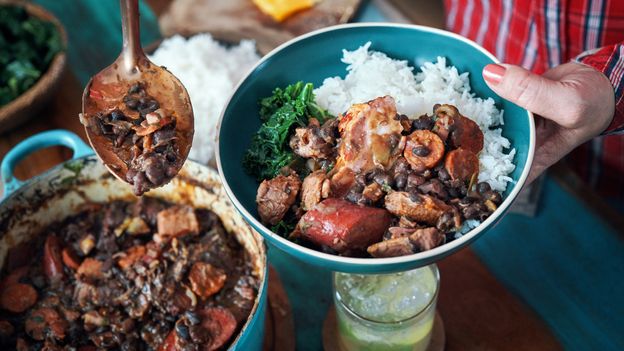
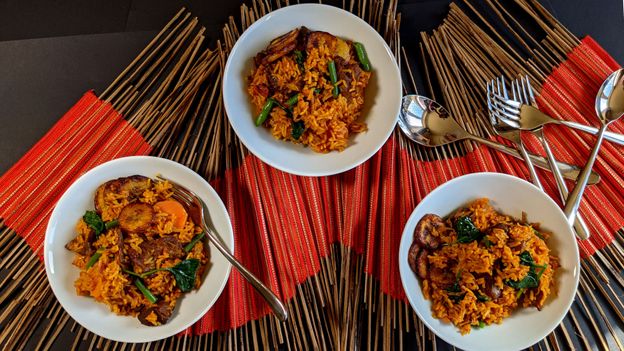
Welcome to a supra, a traditional Georgian feast. In the Republic of Georgia, these epic meals are put on for special occasions or, in this case, no real reason at all. I was in the mountainous Racha region in the north-western part of the country, and in front of me was a lush bounty of Georgian dishes: whole trout doused in walnut sauce; a rich pork-studded bean stew called lobio; baked cheese-bread called khachapuri; blackberry-slathered chicken; lamb stew; chicken with a creamy garlic sauce called shkmeruli; and, in typical Georgian fashion, three different kinds of bread – in what turned out to be a five-hour eating and drinking extravaganza at the home of a friend of a friend.
There was not enough space for the copious amounts of food on the long, rectangular table, so the women of the house started stacking food-loaded dishes on top of each other, sometimes four plates high. It’s not unusual that during these feasts tables will buckle over thanks to the weight set upon them; a hit-you-over-the-head metaphor if there ever was one.
It wasn’t just the wine that made me feel dazed and confused. I was in a serious food coma. Or, more specifically I was experiencing shemomechama, an untranslatable Georgian word. Mako Kavtaradze, founder of the Tbilisi-based Museum of Recipes, told me, “For Georgians, shemomechama means when you are full but you continue eating, you overdose on food.” But more specifically, as Meri Gubeladze, celebrity chef and owner of perpetually packed Tbilisi restaurant Shavi Lomi said, “It’s when you didn’t intend to eat so much but you accidentally did. Usually it’s when something tasted so good that you couldn’t resist. You blame it on the food – and not the eater – for tasting so good.”
And it happens much more than you’d think. “I love this word,” said Tekuna Gachechiladze, chef and owner of the lauded Tbilisi restaurant Culinarium Khasheria. “I don’t remember the first time I heard this word but the experience of shemomechama occurs frequently. It usually happens at a late-night dining experience, when, after a long day of working in the kitchen, I suddenly end up at a late supra, or traditional feast. And even though I may not be hungry at all, I eat and eat, and the experience is mixed in with Georgian singing, laughter, wine drinking and then voila! Shemomechama happens.”
Gubeladze added: “You know how much food Georgians put on table when there’s is a supra… So, most of the time, you are full pretty often but then you keep eating because tasty dishes appear endlessly.”
The word shemomechama and its meaning is inexorably linked to the supra – after all, achieving shemomechama at a supra is inevitable, as there’s such a bounty of edible delights you wonder how the entire population doesn’t have gout.
You may also be interested in:
• Georgia’s giant dumpling born from conquest
• The world’s largest walnut harvest
• Georgia’s addictive cousin to pizza
There is a certain ‘come hither’ quality to Georgian food that makes it irresistible
That may be a huge reason why this word developed in and around a culinary culture like Georgia’s. “There is a certain ‘come hither’ quality to Georgian food that makes it irresistible, and in the context of a feast, when so many different dishes are on the table, it’s always tempting to eat just a little more than you need, because meals always seem to feel like a celebration there,” said Darra Goldstein, author of The Georgian Feast. “Physically, it’s a feeling of having eaten enough (sometimes more than enough) but not being able to resist one last little bite, so that the flavours will linger on the tongue. But the key to understanding shemomechama is that the word signals a lack of intention – it really is as though something compels you to eat just a bit more, even though you don’t really mean to. It just kind of happens.”
Carla Capalbo, author of Tasting Georgia, says, “One of the main ‘rules’ of the supra is that the serving platters should be constantly replenished, and the guest leaves a table as abundantly full as they sat down to, so to ‘accidentally’ eat it all up is quite a challenge.”
Food and drink are often linked to a nation’s identity, especially as a way of distinguishing itself from others – often a foreign, occupying power. In Georgia, there’s a powerful link between food and national awareness. Especially when it comes to the long history of Russian dominance in the region, which began when the Tsarist-led empire invaded Georgia in 1801 and continued through the Soviet era until 1991.
“Since the Russians, unlike former invaders, shared the same religion as the Georgians, religion was no longer a distinguishing factor between ‘us’ (the Georgians) and ‘them’ (the Russians),” writes anthropologist Florian Mühlfried in Sharing the Same Blood – Culture and Cuisine in the Republic of Georgia, published in the Anthropology of Food journal. “The ‘self-othering’ of the Georgian nation had to be based on something else: folk culture. The supra soon became a symbol of that cultural otherness, a manifestation of ‘Georgian’ hospitality based on a distinct way of eating, drinking and feasting. It remained a prime cultural marker of national identity well into Soviet times, embodying resistance to becoming a Societas Sovietica. For post-Soviet Georgians, the supra seems to offer permanent counter-assurance of cultural authenticity in the face of an all-levelling globalisation.”
Kevin Tuite, an anthropologist from the University of Montreal, who has heavily researched culture in the Caucasus, breaks down the semantics of the word: “In a sense, the verb ‘eat’” – or ‘chama’ – “becomes passive, and the subject a sort of indirect object: ‘it got eaten, and I was somehow involved’, more or less. Georgian has quite a few such indirect-involvement verbs, such as shemoexarjeba (I burned through my money without realising it) and shemoesriseba (it [some object in my hand] unintentionally got crushed).”
It got eaten, and I was somehow involved
Mülfried, via email, added: “The main thrust of the word lies in the fact that it ascribes agency to the object rather than the subject. It is an expression of being overwhelmed, similar to the way Georgians express being in love: I am the object, the other is the subject. Somebody, something overwhelmed me. This can be a feeling as well, being overwhelmed by hatred that could turn into violence. Something came over me, and this makes me a victim; in the case of shemomechama, a victim of food that is tasty beyond resistibility.”
How, though, could such a word have been born out of this food culture? “The only conclusion I can come to is that Georgians don’t like to take responsibility for their own actions,” said Gubeladze. We often blame it on 70 years of Soviet occupation, where the state was making every decision for you. But also, it’s easier to blame shemomechama than to admit that you’re a pig!”
I definitely felt like a pig by the time the supra had finished. My friends and I walked back to our guest house in silence, as the shemomechama had long set in. When we got there, the guest-house owner insisted we needed to be fed. We pleaded with her that we couldn’t eat any more, but she was adamant. After all, in Georgia they say that a “guest is a gift from God”.
And so, with that, we sat down at a table in the courtyard and began a new feast all over again; the shemomechama would be sticking around for a few more hours.
Why We Are What We Are is a BBC Travel series examining the characteristics of a country and investigating whether they are true.
Join more than three million BBC Travel fans by liking us on Facebook, or follow us on Twitter and Instagram.
If you liked this story, sign up for the weekly bbc.com features newsletter called “The Essential List”. A handpicked selection of stories from BBC Future, Culture, Worklife and Travel, delivered to your inbox every Friday.