Worklife
  • Login
  • Home
  • News
  • Sport
  • Reel
  • Worklife
  • Travel
  • Future
  • Culture
  • More
    • Music
Monday, December 8, 2025

WORKLIFE

  • Home
  • About Us
  • Remote Control
  • Collective Intelligence
  • Beyond the 9-to-5
  • Worklife 101
  • More
    • Psychology
    • Productivity
    • Technology
    • Japan
    • Time Hackers
No Result
View All Result
WORKLIFE
No Result
View All Result
Home Collective Intelligence

Meetings are terrible. Can an elite team fix that?

May 17, 2020
in Collective Intelligence
3 min read
305 4
0
1.2k
VIEWS
Share on FacebookShare on Twitter


Last year, Allen and his colleagues reviewed academic literature and came away with 10 evidence-backed general principles that raise meeting satisfaction and effectiveness. He shared a summarised version with the group:

Invite only the people who need to be there. Attendees should be limited to those whose expertise is necessary to accomplish the tasks at hand.

Schedule the meeting to match its goals. A meeting shouldn’t be an hour if the content can be effectively discussed in 27 minutes.

Use your agenda wisely. A detailed agenda circulated beforehand allows people to prepare. It becomes useless if not adhered to. Keep discussions focused and on task.

Arrive early – or at the very least, on time. Tardiness wastes everyone’s time. In addition, research shows that a few minutes of pre-meeting chitchat helps people feel more comfortable speaking up in the discussion later.

Debrief afterwards. Immediately after the meeting, leaders should send minutes and action items, and clearly identify the people responsible for following through.

Side benefits

Now, the uncomfortable question: could the meeting about meetings just have been an email?

On a purely informational basis: possibly. The first part of the day was spent in various presentations about meetings, group behaviour, and the like, and during the afternoon the participants broke into groups to brainstorm those ideas about how meetings could go better. 

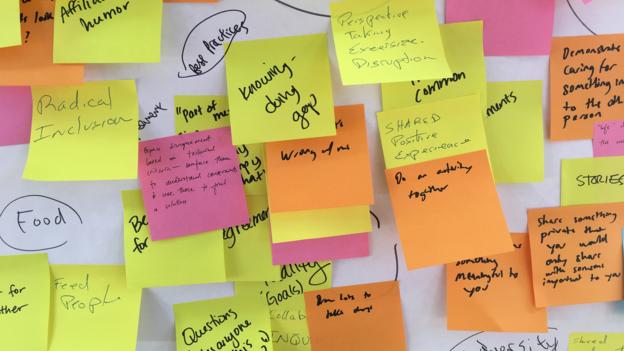
In the group brainstorming sessions, participants tossed out creative ideas: have all participants wear matching jumpsuits to eliminate hierarchy. Trade content at the beginning of a meeting and force colleagues to present one another’s ideas. Give the moderator a heat map to monitor when participants are physically stressed or excited by an idea (yikes). Create a class of professionals whose primary function is to run meetings, or just scrap them altogether and just let chaos unfold.

Yet no cohesive theory of meeting disruption emerged. Despite the abundance of collected talent, it will take far more than one eight-hour workshop to invent a viable meeting replacement. That painful weekly check-in is still on your calendar; you will still be able to hear Paul’s dog in the background the next time he works from home.

Perhaps this experiment reinforces the idea that meetings aren’t the ideal subject for ‘moonshot’-style thinking. Walshe describes high-performance training as 70% evidence-based practices (for an athlete, good sleep and nutrition; for a meeting goer, showing up on time and sticking to the agenda), 20% experimental training, and 10% out-there longshots. Perhaps the same can apply to meetings – but, as Allen and others pointed out, most managers still aren’t even nailing the 70%.

But what would have been lost had they never met at all? Why do any group of people gather in a professional environment?

Some were intrigued by the participant list and excited to meet new potential collaborators. Others wanted to reconnect with people already in their network. For those who focus on meetings for a living, it was a valuable research opportunity. And a few just wanted to get out of their office for a day. And on those fronts, the day was a success.

There are a lot of reasons people meet that have nothing to do with the information on the agenda. A good meeting is one where everyone wants to be there. 


Source link

Related articles

Is this the secret of smart leadership?

How to avoid the ‘competency trap’

Tags: elitefixMeetingsteamterrible
admin

admin

Related Posts

Is this the secret of smart leadership?

by admin
August 25, 2020
0

Amy Yi Ou at the Hong Kong Polytechnic University has found similar benefits in a study of 105 technology companies. Using surveys similar to Owens’,...

How to avoid the ‘competency trap’

by admin
August 22, 2020
0

At launch, the Xerox Alto sold for $32,000 – far beyond most customers’ price range. And despite repeated requests from the researchers at Parc, the...

The reasons why people become incompetent at work

by admin
August 21, 2020
0

There are lots of potential reasons why this might occur, says Shue. The personal drive – even aggression – that is needed to boost your...

How elite teams increase their emotional intelligence

by admin
May 31, 2020
0

That’s perhaps easier said than done. But for teams who are struggling recognise and regulate those emotional undercurrents, Boros has found that a few simple...

The benefits isolation can have on your work

by admin
May 27, 2020
0

Initially, in the information-gathering ‘reconnaissance’ stage of the game, the more connected groups performed well: the ability to pass leads on to all the other...

Next Post

What leader are you? It depends on your parents

Why are some people better at working from home than others?

The office where everyone has a second job

Leave a Reply Cancel reply

Your email address will not be published. Required fields are marked *

CATEGORIES

  • About us
  • Beyond the 9-to-5
  • Collective Intelligence
  • Japan
  • Productivity
  • Psychology
  • Remote Control
  • Technology
  • Time Hackers
  • Worklife 101

RECOMMENDED

Japan

The Japanese city that banned ‘smartphone-walking’

August 25, 2020
Remote Control

Does burnout recovery always require radical change?

November 6, 2020

TAGS

avoid bad BBC Biometric calls changing Collective Control Coronavirus CVs decisions digital elite home Intelligence Japan Japans job lockdown mindset news office pandemic people procrastination Productivity Remote rise selfcontrol space stop success team tech time tips uncertainty video Virtual work workers working Worklife world Zoom
Worklife

© 2020 JBC Reel - Powered byJOOJ.us.

Explore the JBC

  • Home
  • News
  • Sport
  • Reel
  • Worklife
  • Travel
  • Future
  • Culture
  • More

Follow Us

  • About us
  • Beyond the 9-to-5
  • Collective Intelligence
  • Japan
  • Productivity
  • Psychology
  • Remote Control
  • Technology
  • Time Hackers
  • Worklife
  • Worklife 101

© 2020 JBC Reel - Powered byJOOJ.us.

Welcome Back!

Login to your account below

Forgotten Password?

Create New Account!

Fill the forms bellow to register

All fields are required. Log In

Retrieve your password

Please enter your username or email address to reset your password.

Log In
Worklife
More Sites

    MORE

  • Home
  • News
  • Sport
  • Reel
  • Worklife
  • Travel
  • Future
  • Culture
  • More
    • Music
  • Worklife

    Worklife JBC